The K2 Base Camp Trek is widely regarded as one of the most challenging and rewarding trekking adventures in the world. Every year, thousands of trekkers dream of standing beneath the mighty K2, the world’s second-highest mountain at 8,611 meters. However, before planning this unforgettable journey, one question appears more than any other:
The answer is simple: the K2 Base Camp Trek is physically demanding but not technically difficult. Unlike mountaineering expeditions, you don’t need climbing experience, ropes, or advanced alpine skills. However, the combination of high altitude, long trekking days, rugged terrain, glacier crossings, unpredictable weather, and the remote wilderness of the Karakoram makes the K2 Base Camp Trek Difficulty significantly higher than many other famous treks around the world.
One of the biggest reasons why people are concerned about the K2 Base Camp Trek Difficulty is its location. The trek takes you deep into the Karakoram Mountains, far from roads, towns, and modern facilities. Once you leave Askole, you will spend nearly two weeks trekking through valleys, glaciers, and high mountain camps before reaching the legendary Concordia and finally K2 Base Camp. Unlike shorter trekking routes, there are very few opportunities to rest or return quickly, making proper preparation essential.
Altitude is another major factor contributing to the K2 Base Camp Trek Difficulty. Throughout the expedition, trekkers gradually climb from around 3,000 meters in Askole to over 5,100 meters at K2 Base Camp, where the oxygen level is almost half of what it is at sea level. Walking at these elevations naturally becomes more tiring, and your body needs time to acclimatize. Without proper acclimatization, trekkers may experience symptoms of Acute Mountain Sickness (AMS), which is why experienced guides follow carefully planned itineraries that include gradual altitude gain and rest days.
The terrain also makes the K2 Base Camp Trek Difficulty unique. Unlike well-established mountain trails found on some popular trekking routes, much of the journey follows rocky paths, loose moraine, glacier crossings, and uneven surfaces. The famous Baltoro Glacier alone stretches for more than 60 kilometers, requiring trekkers to navigate constantly changing terrain. Although these sections do not require technical climbing skills, they demand good balance, endurance, and concentration.
Another aspect that increases the K2 Base Camp Trek Difficulty is the length of the expedition. Depending on the itinerary, the trek usually lasts 14 to 21 days, with daily hiking times ranging from 6 to 10 hours. Walking continuously for several weeks while carrying a daypack can be physically exhausting, even for experienced hikers. Mental determination is just as important as physical fitness, especially during long days on the trail and changing mountain weather.
Despite its reputation, the K2 Base Camp Trek is achievable for many people with the right preparation. You do not need to be an elite athlete or professional mountaineer. Many first-time high-altitude trekkers successfully complete the journey every year by following a structured training plan, using quality trekking equipment, staying well hydrated, and trekking at a steady pace with experienced local guides.
This guide explains every aspect of the K2 Base Camp Trek Difficulty, including altitude, physical fitness requirements, terrain, weather, daily trekking challenges, acclimatization, and practical preparation tips. By the end of this article, you’ll have a clear understanding of how difficult the K2 Base Camp Trek really is and whether this incredible adventure is the right challenge for you.
Quick Difficulty Rating
Before diving into the details, here’s a quick overview of the K2 Base Camp Trek Difficulty based on the most important factors trekkers should consider.
Difficulty Factor
Rating
Explanation
Physical Difficulty
9/10
The trek involves 14–21 days of hiking, daily walks of 6–10 hours, steep ascents, glacier crossings, and long distances at high altitude. Excellent endurance is required.
Technical Difficulty
3/10
No climbing experience, ropes, or mountaineering skills are required. The route is a trek rather than a technical climb, although rocky and uneven terrain demands careful footing.
Mental Challenge
9/10
The remote environment, long expedition duration, unpredictable weather, limited comforts, and physical fatigue make mental resilience essential throughout the journey.
Altitude
Very High
The trek reaches over 5,100 meters (16,700 ft) at K2 Base Camp, where reduced oxygen levels significantly increase the challenge and require proper acclimatization.
Trek Duration
Long
Most itineraries last between 14 and 21 days, making this one of the longest trekking adventures in Pakistan and the Karakoram.
Overall Difficulty
Challenging
The K2 Base Camp Trek Difficulty is considered high due to its combination of altitude, endurance, remote wilderness, glacier terrain, and extended trekking days. However, with proper preparation and an experienced guide, it is achievable for fit and determined trekkers.
Difficulty Summary
Overall, the K2 Base Camp Trek Difficulty is best described as physically demanding but technically straightforward. While you won’t need mountaineering skills, you should be prepared for long hiking days, high altitude, rugged terrain, and changing weather conditions. If you maintain a good level of fitness, follow a proper training plan, and allow enough time for acclimatization, the K2 Base Camp Trek becomes an achievable and incredibly rewarding adventure.
Why Is the K2 Base Camp Trek So Difficult?
The K2 Base Camp Trek Difficulty is often rated among the highest of all non-technical trekking adventures in the world. Unlike many popular mountain treks that follow well-developed trails with villages, lodges, and easy access to emergency services, the K2 Base Camp Trek takes you deep into the heart of Pakistan’s Karakoram Mountains, where every day presents a new physical and mental challenge.
Although the K2 Base Camp Trek does not require climbing experience or technical mountaineering skills, it demands excellent endurance, determination, and careful preparation. Several factors combine to make the K2 Base Camp Trek Difficulty much greater than many other famous treks, including high altitude, long trekking days, glacier crossings, rocky terrain, unpredictable weather, and the remote nature of the expedition.
Let’s look at each challenge in detail.
High Altitude
The biggest factor contributing to the K2 Base Camp Trek Difficulty is altitude.
The trek begins at approximately 3,000 meters (9,840 feet) in Askole and gradually climbs to over 5,100 meters (16,700 feet) at K2 Base Camp. At this elevation, the oxygen level is nearly 50% lower than at sea level, making every step more physically demanding.
As altitude increases, your body receives less oxygen, causing:
Faster breathing.
Increased heart rate.
Reduced stamina.
Slower recovery.
Greater fatigue.
Many trekkers experience mild symptoms of Acute Mountain Sickness (AMS), such as headaches, loss of appetite, dizziness, or difficulty sleeping. This is why professional trekking operators include acclimatization days in the itinerary to help your body adjust safely.
Proper acclimatization, drinking plenty of water, maintaining a slow trekking pace, and following your guide’s instructions are essential for successfully managing the K2 Base Camp Trek Difficulty at high altitude.
Long Trek Duration
Another reason why the K2 Base Camp Trek Difficulty is considered high is the length of the expedition.
Most itineraries last between 14 and 21 days, depending on the route and operator. Unlike shorter trekking holidays, the K2 Base Camp Trek requires sustained physical effort over two to three weeks.
During this time, trekkers:
Walk almost every day.
Sleep in tents.
Adapt to changing weather.
Recover overnight before hiking again.
The cumulative effect of many consecutive trekking days makes the journey increasingly demanding. Even if each day’s hike feels manageable, the accumulated fatigue becomes noticeable during the second half of the expedition.
Maintaining energy, eating nutritious meals, staying hydrated, and getting enough rest are key to handling the K2 Base Camp Trek Difficulty over such a long period.
Daily Walking Distance
The K2 Base Camp Trek Difficulty is also influenced by the amount of walking required each day.
Trekkers typically hike:
6 to 10 hours per day.
Around 10 to 20 kilometers daily, depending on the itinerary.
With frequent elevation changes and uneven terrain.
Some days involve gradual walks across glacial valleys, while others include long ascents over rocky moraine and glacier sections.
Although porters carry your main duffel bag, you will still carry your daypack containing water, extra clothing, snacks, camera equipment, and personal essentials. Walking long distances while carrying even a light backpack becomes increasingly challenging at high altitude.
Good cardiovascular fitness and endurance training before the expedition significantly reduce the overall K2 Base Camp Trek Difficulty.
Rocky Terrain
Unlike many famous trekking routes with well-maintained trails, the K2 Base Camp Trek follows rugged mountain terrain for much of the journey.
Trekkers encounter:
Loose rocks.
Boulder fields.
Uneven mountain paths.
Moraine trails.
Gravel slopes.
Steep ascents and descents.
Walking on unstable ground requires careful foot placement and constant concentration. While the terrain is not technically dangerous for experienced trekkers, it demands balance and strong leg muscles.
Quality trekking boots with good ankle support and trekking poles greatly improve stability and help reduce fatigue, making the K2 Base Camp Trek Difficulty more manageable.
Baltoro Glacier
One of the most unique features of the K2 Base Camp Trek is crossing the legendary Baltoro Glacier.
Stretching over 60 kilometers, the Baltoro Glacier is one of the longest glaciers outside the polar regions and forms a major part of the trekking route.
Unlike smooth ice fields, the glacier consists of:
Rocks.
Ice beneath loose debris.
Small ridges.
Uneven surfaces.
Constant elevation changes.
Walking across the glacier can be slower and more tiring than hiking on regular mountain trails. Every step requires attention, making this one of the most physically demanding sections of the K2 Base Camp Trek Difficulty.
Despite its rugged appearance, the glacier can be crossed safely with experienced guides who know the route and current conditions.
Weather Conditions
Mountain weather changes rapidly in the Karakoram, adding another layer to the K2 Base Camp Trek Difficulty.
Trekkers may experience:
Bright sunshine.
Strong winds.
Freezing mornings.
Afternoon clouds.
Rain at lower elevations.
Snow at higher camps.
Temperatures can vary dramatically throughout the day. Warm afternoons may quickly give way to freezing nights, particularly above Concordia.
These changing conditions require proper clothing, including waterproof layers, thermal insulation, gloves, and warm sleeping bags.
Being prepared for all weather conditions makes the K2 Base Camp Trek Difficulty much easier to manage.
Remote Location
Few trekking destinations in the world are as remote as the K2 Base Camp Trek.
After leaving Askole, there are:
No hotels.
No permanent villages.
Very limited communication.
No shops.
Minimal medical facilities.
Trekkers rely entirely on their expedition team for food, camping, logistics, and safety.
This remoteness increases both the physical and psychological demands of the journey. Rescue operations can also take longer than on more accessible trekking routes.
Choosing an experienced trekking company with qualified guides is one of the best ways to safely manage the K2 Base Camp Trek Difficulty.
Mental Challenge
While physical fitness is essential, many experienced trekkers believe the greatest part of the K2 Base Camp Trek Difficulty is mental.
During the expedition, you must remain motivated despite:
Long hiking days.
Physical exhaustion.
Cold nights.
Limited comfort.
Basic camping conditions.
Slow progress at high altitude.
Some days may feel repetitive or especially tiring, particularly during glacier crossings or when weather conditions are poor.
A positive mindset, patience, and determination often make the difference between completing the trek and turning back early.
Fortunately, the incredible scenery—including the Baltoro Glacier, Trango Towers, Masherbrum, Broad Peak, Concordia, and finally K2 itself—provides constant motivation throughout the journey.
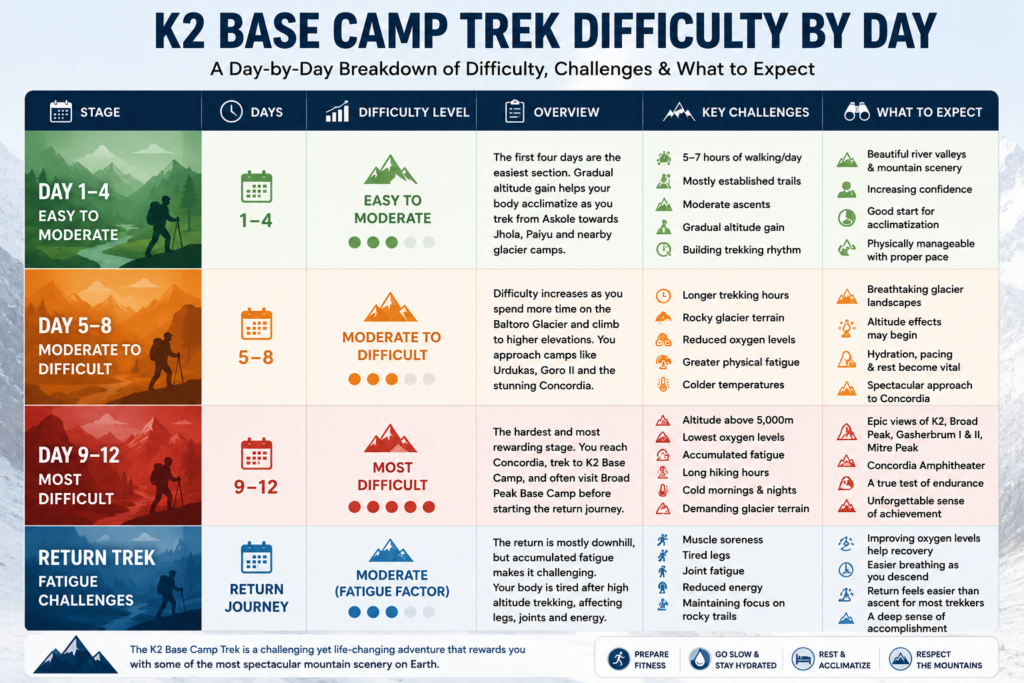
K2 Base Camp Trek Difficulty by Day
The K2 Base Camp Trek Difficulty is not the same throughout the expedition. Some days are relatively easy and allow your body to adjust to the altitude, while others involve longer distances, glacier travel, and higher elevations that require greater physical effort.
Understanding how the difficulty changes each day helps trekkers prepare both physically and mentally for the journey.
Day 1–4: Easy to Moderate
The first four days are generally considered the easiest section of the K2 Base Camp Trek, although they still require a reasonable level of fitness.
During these days, trekkers travel from Askole toward camps such as Jhola, Paiyu, and nearby glacier camps. The altitude gain is gradual, allowing your body to begin acclimatizing while you settle into the rhythm of daily trekking.
Expect:
5–7 hours of walking per day.
Mostly established mountain trails.
Moderate ascents.
Beautiful river valleys and mountain scenery.
Increasing confidence with your trekking routine.
Although these days are physically manageable, avoid walking too fast. Conserving energy early in the expedition will make the more difficult stages much easier later on.
Day 5–8: Moderate to Difficult
The K2 Base Camp Trek Difficulty increases noticeably during this stage as trekkers spend more time on the Baltoro Glacier and climb to higher elevations.
Highlights include camps such as Urdukas, Goro II, and the spectacular approach toward Concordia.
Challenges during these days include:
Longer trekking hours.
Rocky glacier terrain.
Reduced oxygen levels.
Greater physical fatigue.
Colder temperatures.
Most trekkers begin to notice the effects of altitude, with breathing becoming heavier during climbs. Proper hydration, slow pacing, and regular breaks become increasingly important.
Day 9–12: Most Difficult
This is widely considered the hardest section of the K2 Base Camp Trek.
Trekkers reach Concordia, continue toward K2 Base Camp, and often visit Broad Peak Base Camp before beginning the return journey.
By this stage, several factors combine to create the highest level of K2 Base Camp Trek Difficulty:
Altitude above 5,000 meters.
Lowest oxygen levels.
Accumulated fatigue from previous trekking days.
Long hiking hours.
Cold mornings and nights.
Physically demanding glacier terrain.
Despite the challenge, these are also the most rewarding days, offering breathtaking views of K2, Broad Peak, Gasherbrum I, Gasherbrum II, Mitre Peak, and the famous Concordia amphitheater.
Standing at K2 Base Camp after days of trekking is an unforgettable achievement that makes every challenge worthwhile.
Return Trek: Fatigue Challenges
Although the return route is mostly downhill, many trekkers are surprised that it still feels challenging.
The main reason is accumulated fatigue. After spending many days trekking at high altitude, your muscles are tired, and long descents can place additional strain on your knees, ankles, and feet.
Common challenges during the return include:
Muscle soreness.
Tired legs.
Joint fatigue.
Reduced energy levels.
Maintaining concentration on rocky trails.
The good news is that as you descend, oxygen levels gradually increase, making breathing easier and improving recovery. Many trekkers find the return journey physically easier than the ascent, even though fatigue remains a factor.
By the time you arrive back in Askole, you’ll have completed one of the world’s greatest trekking adventures and gained a deep appreciation for why the K2 Base Camp Trek Difficulty is respected by trekkers across the globe.
K2-base-camp-trek-difficulty
Altitude and Acclimatization
One of the biggest reasons behind the K2 Base Camp Trek Difficulty is the extreme altitude. Unlike many trekking destinations around the world, the K2 Base Camp Trek takes you well above 5,000 meters, where the air contains significantly less oxygen than at sea level. As you gain elevation, your body must gradually adapt to these conditions through a process called acclimatization.
Proper acclimatization is the key to completing the K2 Base Camp Trek safely and successfully. Trekkers who ascend too quickly or ignore altitude-related symptoms are at a much greater risk of developing Acute Mountain Sickness (AMS). This is why professional trekking companies carefully design itineraries with gradual altitude gain and rest days.
Understanding how altitude affects your body is essential for anyone planning the K2 Base Camp Trek.
Altitude Profile
The K2 Base Camp Trek Difficulty increases steadily as you climb higher into the Karakoram Mountains. The trek begins in Askole at approximately 3,000 meters (9,840 feet) and reaches its highest point at K2 Base Camp, which stands at around 5,150 meters (16,896 feet) above sea level.
Below is a general altitude profile of the trek:
Location
Approximate Altitude
Islamabad
540 m
Skardu
2,230 m
Askole
3,000 m
Jhola Camp
3,200 m
Paiyu Camp
3,450 m
Urdukas Camp
4,050 m
Goro II Camp
4,300 m
Concordia
4,691 m
Broad Peak Base Camp
4,900 m
K2 Base Camp
5,150 m
As the altitude increases, oxygen levels decrease significantly. At K2 Base Camp, the available oxygen is nearly half of what it is at sea level. This reduced oxygen makes even simple activities such as walking, climbing small slopes, or carrying a daypack much more physically demanding.
The gradual increase in elevation throughout the itinerary helps your body adapt naturally, reducing the overall K2 Base Camp Trek Difficulty.
AMS Risk (Acute Mountain Sickness)
One of the most important health concerns during the K2 Base Camp Trek is Acute Mountain Sickness (AMS).
AMS occurs when your body does not have enough time to adjust to high altitude. It can affect anyone, regardless of age or fitness level. Even experienced trekkers and professional athletes can develop AMS if they ascend too quickly.
The risk of AMS increases significantly once you climb above 2,500 meters, and the chances become much higher above 4,000 meters, which is why the K2 Base Camp Trek Difficulty is closely linked to proper acclimatization.
Fortunately, most cases of AMS are mild and improve with rest and proper acclimatization. Experienced trekking guides monitor participants daily and make sure everyone is adapting well before continuing to higher camps.
Ignoring AMS symptoms can lead to more serious altitude illnesses, making it essential to take every symptom seriously.
Symptoms of Altitude Sickness
Recognizing the early symptoms of AMS is one of the most important parts of staying safe during the K2 Base Camp Trek.
Common symptoms include:
Persistent headache.
Shortness of breath.
Fatigue and unusual tiredness.
Loss of appetite.
Nausea or vomiting.
Dizziness.
Difficulty sleeping.
Rapid heartbeat.
Reduced energy levels.
Difficulty concentrating.
These symptoms often appear after arriving at a higher campsite or following a long day of trekking.
If symptoms become severe, trekkers may experience:
Difficulty walking in a straight line.
Severe confusion.
Persistent vomiting.
Extreme weakness.
Chest tightness.
Blue lips or fingernails.
Difficulty breathing even while resting.
These are signs of serious altitude illness and require immediate descent and medical attention.
Professional guides are trained to recognize these warning signs early, helping reduce the overall risks associated with the K2 Base Camp Trek Difficulty.
How to Prevent Altitude Sickness
Although altitude cannot be avoided during the K2 Base Camp Trek, there are several proven ways to reduce the risk of AMS.
The most effective prevention methods include:
Climb Slowly
Gradual altitude gain allows your body enough time to adapt naturally.
Follow the Itinerary
Never try to rush the trek or skip acclimatization days.
Stay Hydrated
Drink at least 3–4 liters of water every day to maintain proper hydration.
Eat Well
Consume enough carbohydrates and calories to maintain your energy levels.
Avoid Alcohol and Smoking
Both reduce your body’s ability to acclimatize effectively.
Sleep Well
Proper rest is essential for recovery at high altitude.
Listen to Your Guide
Experienced guides understand the K2 Base Camp Trek Difficulty and know when a trekker needs additional rest or medical attention.
Consider Preventive Medication
Some trekkers consult their doctor about medications such as Diamox before beginning the trek. Always seek professional medical advice before taking any medication.
Following these precautions greatly improves your chances of completing the K2 Base Camp Trek safely while minimizing the effects of altitude.
Physical Fitness Requirements
The K2 Base Camp Trek Difficulty is best managed by arriving in excellent physical condition. While you do not need to be a professional athlete or mountaineer, you should be capable of walking for several hours each day over challenging mountain terrain at high altitude.
Preparing your body several months before the expedition will make the trek significantly more enjoyable and increase your chances of reaching K2 Base Camp successfully.
A balanced training program should focus on cardiovascular fitness, leg strength, endurance, flexibility, and overall stamina.
Cardio Fitness
Cardiovascular fitness is one of the most important aspects of preparing for the K2 Base Camp Trek.
Strong heart and lung capacity help your body use oxygen more efficiently, especially at high altitude where oxygen levels are much lower.
Recommended cardio exercises include:
Hiking.
Trail running.
Jogging.
Cycling.
Swimming.
Stair climbing.
Rowing machine.
Incline treadmill walking.
Aim for 4–5 cardio sessions per week, gradually increasing both intensity and duration.
By improving your cardiovascular fitness, you’ll find the long hiking days of the K2 Base Camp Trek much easier to manage.
Strength Training
Strong muscles reduce fatigue and improve balance on rocky trails and glacier crossings.
Focus on strengthening:
Quadriceps.
Hamstrings.
Calves.
Glutes.
Core muscles.
Lower back.
Shoulders.
Recommended exercises include:
Squats.
Lunges.
Step-ups.
Deadlifts.
Planks.
Wall sits.
Farmer’s carries.
Training with a backpack is especially useful because it simulates carrying your daypack during the K2 Base Camp Trek.
Perform strength training 2–3 times per week.
Endurance
Because the K2 Base Camp Trek Difficulty involves trekking for nearly two weeks, endurance is just as important as strength.
Try to complete long training hikes on weekends.
Gradually increase your hiking distance until you can comfortably walk:
15–20 km.
6–8 hours.
Consecutive days.
Training your body to perform over multiple days helps prepare for the continuous demands of the expedition.
Flexibility
Flexibility is often overlooked but plays an important role in preventing injuries during the K2 Base Camp Trek.
Regular stretching improves:
Joint mobility.
Muscle recovery.
Balance.
Posture.
Walking efficiency.
Spend 10–15 minutes stretching after every workout.
Yoga and mobility exercises are also excellent additions to your training program.
Improved flexibility reduces muscle soreness and helps you recover more quickly between trekking days.
Recommended Training Plan
Ideally, begin preparing for the K2 Base Camp Trek at least 12 weeks before departure.
Weeks 1–4: Build Your Base
Focus on developing general fitness.
Walk or jog 3–5 times each week.
Begin basic strength training.
Stretch after every workout.
Complete one long weekend hike.
Weeks 5–8: Increase Intensity
Start training specifically for trekking.
Hike on hills.
Increase backpack weight.
Add stair climbing sessions.
Increase hiking distance.
Improve endurance with longer workouts.
Weeks 9–12: Simulate Trek Conditions
Prepare your body for the real expedition.
Complete back-to-back hiking days.
Carry a loaded backpack.
Practice walking on uneven terrain.
Continue strength and cardio training.
Prioritize recovery, hydration, and nutrition.
Final Week Before Departure
Reduce training intensity to allow your body to recover fully.
Focus on:
Light walking.
Gentle stretching.
Good sleep.
Healthy meals.
Hydration.
Checking your trekking equipment.
Arriving well-rested is just as important as arriving fit
Can Beginners Complete the K2 Base Camp Trek?
One of the most common questions people ask before booking this adventure is:
“Can beginners complete the K2 Base Camp Trek?”
The answer is yes—but with the right preparation.
The K2 Base Camp Trek Difficulty is undoubtedly high, but it is important to understand that this is a trek, not a mountaineering expedition. Thousands of trekkers successfully complete the K2 Base Camp Trek every year without any previous climbing experience.
However, beginners should never underestimate the physical and mental demands of the journey. The trek covers nearly two weeks of hiking through remote mountain valleys, glaciers, rocky trails, and high-altitude camps. Success depends far more on fitness, preparation, and determination than on previous mountaineering experience.
If you train properly, choose a reputable trekking company, and follow a well-planned itinerary with adequate acclimatization, completing the K2 Base Camp Trek is an achievable goal even for first-time high-altitude trekkers.
Who Can Do the K2 Base Camp Trek?
The K2 Base Camp Trek is suitable for anyone who is healthy, physically fit, and willing to prepare for the expedition.
You are likely to complete the trek successfully if you:
Have good overall health.
Can comfortably hike for 6–10 hours a day.
Enjoy outdoor adventures.
Are mentally prepared for camping and remote environments.
Are committed to following your guide’s instructions.
Complete a proper training program before the trek.
Understand the importance of acclimatization.
Many successful trekkers are not professional athletes. They include teachers, engineers, students, photographers, business owners, and retired travelers who prepared properly before arriving in Pakistan.
Age is generally less important than fitness. Every year, trekkers in their 50s and even 60s successfully complete the K2 Base Camp Trek because they arrive well-trained and maintain a steady pace throughout the expedition.
Who Should Avoid the K2 Base Camp Trek?
Although many people can complete the trek, it is not suitable for everyone.
You should carefully reconsider the K2 Base Camp Trek if you:
Have serious heart disease.
Suffer from severe lung conditions.
Have uncontrolled high blood pressure.
Recently underwent major surgery.
Have medical conditions that prevent high-altitude travel.
Are unable to walk long distances.
Are unwilling to train before the expedition.
Do not enjoy camping or remote environments.
People with previous altitude-related medical problems should consult their doctor before planning the K2 Base Camp Trek.
If you have any medical concerns, always seek professional medical advice before participating in a high-altitude expedition.
Do You Need Previous Trekking Experience?
Previous trekking experience is helpful—but it is not essential.
Many people believe the K2 Base Camp Trek Difficulty requires years of mountain experience. In reality, good physical fitness is usually more important than previous trekking history.
If you have completed treks such as:
Fairy Meadows Trek
Rush Lake Trek
Annapurna Base Camp Trek
Everest Base Camp Trek
Kilimanjaro
Multi-day backpacking trips
you will likely adapt more quickly to the physical demands.
However, even if you have never completed a high-altitude trek before, you can still successfully reach K2 Base Camp by preparing well.
Your trekking company will provide experienced guides who know the route, monitor your health, and help you acclimatize safely throughout the expedition.
Tips for First-Time Trekkers
If this will be your first major trekking adventure, these practical tips will make the K2 Base Camp Trek Difficulty much easier to manage.
Start Training Early
Begin preparing at least three months before departure.
Build your cardiovascular fitness through hiking, jogging, cycling, stair climbing, and long walks.
Break in Your Boots
Never bring brand-new trekking boots to the Karakoram.
Wear them during training hikes so they become comfortable before the expedition.
Learn to Walk Slowly
One of the biggest mistakes beginners make is walking too fast.
A slow, steady pace conserves energy, improves acclimatization, and reduces fatigue.
Mountain guides often repeat one simple rule:
“Walk slowly, arrive successfully.”
Stay Hydrated
Drink plenty of water throughout the day.
Hydration improves acclimatization and helps reduce the risk of altitude sickness.
Pack Smart
Carry only essential items in your daypack.
A lighter backpack makes long trekking days much easier.
Trust Your Guides
Professional local guides have years of experience on the K2 Base Camp Trek.
Follow their advice regarding pacing, hydration, acclimatization, and safety.
Stay Positive
Some days will feel physically demanding.
Maintaining a positive mindset often becomes your greatest strength during the expedition.
Remember that every difficult day brings you one step closer to standing beneath the world’s second-highest mountain.
Technical Difficulty
Although the K2 Base Camp Trek Difficulty is considered physically demanding, many people are surprised to learn that the trek is not technically difficult.
This is one of the biggest misconceptions about the expedition.
Unlike climbing K2 itself—which is considered one of the most dangerous mountains on Earth—the K2 Base Camp Trek is a trekking route.
It does not involve technical mountaineering, rock climbing, or glacier climbing.
Instead, the challenge comes from:
High altitude.
Long trekking days.
Rocky terrain.
Glacier walking.
Physical endurance.
Understanding the technical aspects helps trekkers prepare confidently for the adventure.
Do You Need Climbing Skills?
No.
You do not need climbing experience to complete the K2 Base Camp Trek.
The trekking route follows established trails and glacier paths used by expedition teams every trekking season.
There is:
No rock climbing.
No ice climbing.
No vertical ascents.
No technical mountaineering.
If you can comfortably hike on uneven mountain terrain, you already possess the basic skills required for the trek.
This is why the technical difficulty of the K2 Base Camp Trek is generally rated only 3 out of 10, even though the overall K2 Base Camp Trek Difficulty is much higher due to altitude and endurance.
Do You Need Ropes?
In normal summer trekking conditions, no ropes are required.
Professional trekking companies organize the route so trekkers can safely walk to K2 Base Camp without using ropes or climbing equipment.
Your guide will lead the group across glacier sections and rocky terrain using established trekking routes.
Only in rare situations—such as unusual snow conditions or temporary route changes—might guides use safety ropes for extra security.
For the vast majority of trekkers, ropes are not part of the standard K2 Base Camp Trek.
Snow & Ice
Many people imagine walking across deep snow for the entire expedition.
In reality, most of the trekking season (June to September) features surprisingly little snow on the main trail.
Instead, trekkers spend much of the journey crossing:
Glacier moraine.
Rocky ice-covered terrain.
Loose stones.
Hard-packed glacier surfaces.
Small patches of snow may still be present near higher camps, especially early or late in the trekking season.
Because of the uneven glacier surface, sturdy waterproof trekking boots with good grip are essential.
Although walking on glaciers requires concentration, it does not require crampons or technical glacier training during normal trekking conditions.
River Crossings
River crossings are another concern for many first-time trekkers.
Fortunately, most rivers along the K2 Base Camp Trek are crossed using:
Wooden bridges.
Metal bridges.
Established crossing points.
Large river crossings are carefully selected by local guides to ensure safety.
During periods of increased glacier melt, smaller streams may become more challenging in the afternoon.
Your guides will always choose the safest crossing locations and assist the group whenever necessary.
While river crossings add excitement to the journey, they are generally not a major contributor to the overall K2 Base Camp Trek Difficulty.
Technical Difficulty Summary
Although the K2 Base Camp Trek Difficulty is often rated among the world’s toughest trekking adventures, its challenge comes from endurance, altitude, and remote wilderness—not technical climbing.
You do not need to be a mountaineer, use ropes, or have previous climbing experience. With good physical fitness, careful preparation, and the support of experienced guides, most determined trekkers can safely complete the K2 Base Camp Trek and experience one of the most spectacular mountain journeys on Earth.
Biggest Challenges on the Trek
The K2 Base Camp Trek Difficulty is influenced by several factors that make this expedition one of the world’s most demanding trekking adventures. While the trek is not technically difficult, the combination of extreme altitude, harsh weather, rugged terrain, and physical endurance creates challenges that every trekker should understand before setting out.
Knowing these challenges in advance allows you to prepare properly, reduce risks, and enjoy the journey with greater confidence. Below are the biggest obstacles you’ll encounter during the K2 Base Camp Trek.
Cold Nights
One of the first challenges trekkers notice is the cold mountain nights.
As the K2 Base Camp Trek climbs higher into the Karakoram, temperatures drop significantly after sunset. Even during the peak trekking season from June to August, nighttime temperatures at higher camps such as Goro II, Concordia, and K2 Base Camp often fall below freezing.
Typical night temperatures include:
Paiyu Camp: 5°C to 10°C
Urdukas Camp: 0°C to 5°C
Goro II Camp: -5°C to 0°C
Concordia: -8°C to -2°C
K2 Base Camp: -10°C to -3°C
Cold nights can make sleeping difficult, especially for trekkers who are not accustomed to camping at high altitude. Poor sleep may also increase fatigue during the following day’s hike, making the K2 Base Camp Trek Difficulty feel even greater.
To stay comfortable, trekkers should carry:
A high-quality four-season sleeping bag.
Thermal base layers.
Down jacket.
Warm hat.
Insulated gloves.
Thick wool socks.
Professional trekking companies also provide quality sleeping tents that help protect against strong winds and freezing temperatures.
Thin Air
Perhaps the biggest contributor to the K2 Base Camp Trek Difficulty is the thin air found at high altitude.
As you climb above 4,000 meters, oxygen levels decrease dramatically. By the time you reach K2 Base Camp at approximately 5,150 meters, the air contains nearly half the oxygen available at sea level.
Because of this, even simple tasks become more demanding.
Trekkers often notice:
Faster breathing.
Increased heart rate.
Slower walking pace.
Faster fatigue.
Reduced physical performance.
This is completely normal and affects everyone, regardless of fitness level.
The key to handling thin air is to:
Walk slowly.
Stay hydrated.
Eat enough calories.
Get proper rest.
Follow the acclimatization schedule.
Accepting a slower pace is one of the best ways to overcome the altitude-related challenges of the K2 Base Camp Trek.
Long Hiking Days
Another major factor behind the K2 Base Camp Trek Difficulty is the amount of walking required each day.
Unlike shorter trekking holidays, this expedition involves continuous hiking for nearly two weeks.
Typical trekking days include:
6–10 hours of walking
10–20 kilometers
Frequent altitude gain
Rocky glacier terrain
Heavy physical effort
Some days feel relatively easy, while others require crossing glacier moraine for many hours without seeing a single village or road.
Although porters carry your main luggage, you’ll still carry your personal daypack containing water, snacks, camera equipment, extra clothing, and other essentials.
By the second week of the expedition, accumulated fatigue becomes one of the biggest challenges. This is why endurance training before the trek is so important.
Limited Comfort
Unlike luxury trekking destinations, the K2 Base Camp Trek takes place in one of the most remote wilderness areas on Earth.
Trekkers should expect a simple camping lifestyle throughout the expedition.
There are:
No luxury hotels.
No restaurants.
Very limited mobile signal.
No supermarkets.
Basic toilet facilities.
Tent accommodation every night after Askole.
Daily life revolves around:
Camping.
Walking.
Eating.
Sleeping.
Preparing for the next day’s trek.
For some trekkers, adapting to this simple lifestyle becomes part of the overall K2 Base Camp Trek Difficulty. However, many also find it to be one of the most rewarding aspects of the journey, allowing them to disconnect from modern life and fully experience the Karakoram wilderness.
Changing Weather
Mountain weather is famously unpredictable, and this is especially true in the Karakoram.
During the K2 Base Camp Trek, weather conditions can change within minutes.
Trekkers may experience:
Warm sunshine.
Strong mountain winds.
Cloud cover.
Rain at lower elevations.
Snow near higher camps.
Freezing mornings.
Bright blue skies in the afternoon.
Weather changes not only affect comfort but can also influence trail conditions and hiking speed.
Packing appropriate clothing is essential.
Your layering system should include:
Moisture-wicking base layer.
Fleece mid-layer.
Down jacket.
Waterproof shell.
Waterproof trousers.
Warm gloves.
Sun hat.
Being prepared for all weather conditions greatly reduces the overall K2 Base Camp Trek Difficulty.
Common Mistakes That Make the Trek Harder
Although the K2 Base Camp Trek Difficulty is naturally challenging, many trekkers unintentionally make mistakes that increase the difficulty even further.
Fortunately, these mistakes are easy to avoid with proper preparation and the guidance of experienced trekking leaders.
Walking Too Fast
One of the most common mistakes beginners make is trying to walk too quickly.
Many trekkers start the expedition with plenty of energy and attempt to maintain a fast pace during the first few days.
This often leads to:
Early exhaustion.
Muscle fatigue.
Poor acclimatization.
Increased risk of altitude sickness.
Experienced mountain guides follow a simple philosophy:
“Walk slowly, breathe deeply, and save your energy.”
A steady pace allows your body to adapt to altitude while conserving energy for the more demanding sections of the trek.
Poor Hydration
Dehydration is another major factor that increases the K2 Base Camp Trek Difficulty.
At high altitude, your body loses water much faster through breathing and physical activity.
Without proper hydration, trekkers may experience:
Headaches.
Fatigue.
Muscle cramps.
Poor concentration.
Increased risk of AMS.
Most guides recommend drinking 3–4 liters of water every day, even if you don’t feel thirsty.
Warm soups, tea, and electrolyte drinks also help maintain proper hydration throughout the expedition.
Wrong Gear
Bringing unsuitable equipment can make the K2 Base Camp Trek far more difficult than necessary.
Common gear mistakes include:
Poor-quality trekking boots.
Cotton clothing.
Inadequate sleeping bags.
Heavy backpacks.
Cheap rain jackets.
Incorrect backpack fit.
Investing in reliable trekking equipment improves comfort, reduces injuries, and helps you enjoy the journey much more.
Always test your gear during training hikes before traveling to Pakistan.
Skipping Training
Many people underestimate the physical demands of the K2 Base Camp Trek.
Some assume they can simply arrive and complete the expedition without preparation.
Unfortunately, this often leads to:
Excessive fatigue.
Muscle soreness.
Knee pain.
Slow recovery.
Increased risk of quitting.
Preparing for at least 8–12 weeks before departure significantly improves your chances of successfully completing the trek.
Training should include:
Hiking.
Stair climbing.
Strength exercises.
Cardio workouts.
Long weekend walks.
Ignoring Altitude Symptoms
Ignoring early signs of altitude sickness is one of the most dangerous mistakes trekkers can make.
Some people try to continue hiking despite experiencing:
Severe headaches.
Nausea.
Dizziness.
Extreme fatigue.
Difficulty breathing.
Doing so may allow mild AMS to develop into more serious altitude illnesses.
Always report any symptoms to your guide immediately.
Professional trekking companies prioritize safety above reaching the destination, and sometimes an extra rest day or descending to a lower altitude is the safest decision.
Carrying Too Much Weight
Although porters transport your main duffel bag, your daypack still travels with you every day.
Many first-time trekkers pack unnecessary items, making their backpack much heavier than needed.
Your daypack should ideally contain only:
Water.
Snacks.
Camera.
Waterproof jacket.
Warm layer.
Personal medication.
Sunglasses.
Sunscreen.
Gloves.
Keeping your backpack between 5 and 8 kilograms helps reduce fatigue and makes long hiking days much more comfortable.
Final Thoughts
The K2 Base Camp Trek Difficulty is undoubtedly high, but most challenges can be managed with proper preparation, the right equipment, and a disciplined approach. Cold nights, thin air, long hiking days, and unpredictable weather are all part of the adventure, while avoiding common mistakes—such as walking too fast, neglecting hydration, skipping training, or carrying excessive weight—can make the journey significantly more enjoyable.
By preparing both physically and mentally, you’ll be well-equipped to overcome these challenges and experience one of the world’s most spectacular trekking expeditions.
How to Prepare for the K2 Base Camp Trek
Proper preparation is the key to overcoming the K2 Base Camp Trek Difficulty. While the trek is physically demanding, it becomes much more manageable if you arrive well-trained, properly equipped, mentally prepared, and following a healthy nutrition plan.
Many trekkers assume that only experienced mountaineers can complete the K2 Base Camp Trek, but this is not true. With the right preparation, even first-time high-altitude trekkers can successfully reach K2 Base Camp. The secret is to start preparing several months before your departure rather than waiting until the last minute.
Below are the four essential areas you should focus on before beginning your adventure.
3-Month Training Plan
The best way to prepare for the K2 Base Camp Trek is to begin training at least 12 weeks before departure. A structured training plan allows your body to gradually develop the strength, endurance, and cardiovascular fitness needed for long days on the trail.
Month 1: Build Your Fitness Base
The first month should focus on improving your general fitness and creating a consistent workout routine.
Your weekly schedule might include:
Walking or jogging for 30–45 minutes, 4–5 days per week.
Two sessions of strength training focusing on the legs and core.
One longer hike during the weekend.
Daily stretching to improve flexibility.
The goal during this phase is not speed but consistency. Building a strong fitness foundation makes the later stages of training much easier.
Month 2: Increase Strength and Endurance
By the second month, you should begin training specifically for the demands of the K2 Base Camp Trek.
Increase the intensity of your workouts by:
Hiking on hills or mountain trails.
Climbing stairs while carrying a backpack.
Extending your weekend hikes to 15–20 km.
Increasing strength training to three sessions per week.
Adding cycling or swimming for extra cardiovascular conditioning.
This stage helps your body adapt to longer periods of continuous movement and prepares your muscles for uneven terrain.
Month 3: Simulate Trekking Conditions
The final month should closely resemble the conditions you will experience during the K2 Base Camp Trek.
Practice:
Hiking on consecutive days.
Carrying a 5–8 kg backpack.
Walking on rocky or uneven terrain.
Spending 6–8 hours on your feet.
Recovering properly between long hikes.
During the final week before departure, reduce your training intensity to allow your body to recover. Focus on light exercise, stretching, hydration, and quality sleep.
Following this training plan significantly reduces the K2 Base Camp Trek Difficulty and increases your chances of completing the expedition comfortably.
Gear Preparation
The right equipment plays a major role in reducing the K2 Base Camp Trek Difficulty. High-quality gear keeps you warm, dry, and comfortable throughout the expedition while helping prevent injuries and fatigue.
Your gear should be tested well before departure to ensure everything fits properly and performs as expected.
Essential Clothing
Dress using a layering system that allows you to adapt to changing temperatures.
Recommended clothing includes:
Moisture-wicking base layers.
Fleece jacket or mid-layer.
Insulated down jacket.
Waterproof shell jacket.
Waterproof trousers.
Hiking pants.
Thermal underwear.
Warm hat.
Sun hat.
Gloves.
Wool hiking socks.
Footwear
Your boots are one of the most important pieces of equipment.
Choose:
Waterproof trekking boots.
Strong ankle support.
Durable sole with excellent grip.
Boots that have already been broken in during training hikes.
Never wear brand-new boots on the expedition.
Backpack and Sleeping Equipment
Bring:
A comfortable 30–40 liter daypack.
Rain cover.
Four-season sleeping bag rated to at least -15°C.
Trekking poles to reduce pressure on your knees.
Headlamp with spare batteries.
Personal Essentials
Don’t forget:
Sunglasses with UV protection.
Sunscreen (SPF 50+).
Lip balm.
Water bottles or hydration bladder.
Personal medications.
First aid kit.
Power bank.
Camera.
Passport and travel documents.
Packing smartly and avoiding unnecessary items helps keep your daypack light, making the K2 Base Camp Trek Difficulty much easier to manage.
Mental Preparation
Many experienced trekkers say that the greatest challenge of the K2 Base Camp Trek is mental rather than physical.
For nearly two weeks, you’ll be living in tents, walking long distances, sleeping in cold conditions, and dealing with the physical effects of high altitude. There are no luxury hotels, cafés, or modern conveniences once you leave Askole.
To prepare mentally:
Accept that some days will be physically demanding.
Stay patient during slow progress at high altitude.
Focus on one day at a time rather than the entire expedition.
Maintain a positive attitude when conditions become difficult.
Trust your guides and teammates.
Celebrate small milestones, such as reaching each campsite.
Mental resilience becomes especially important during challenging sections like the Baltoro Glacier and the final approach to K2 Base Camp.
Remember that every difficult day brings you closer to one of the most spectacular mountain landscapes on Earth.
Nutrition
Good nutrition is essential for maintaining energy throughout the K2 Base Camp Trek.
Your body burns thousands of calories each day while trekking at high altitude. Eating enough nutritious food helps improve recovery, maintain strength, and reduce fatigue.
A balanced trekking diet should include:
Carbohydrates
Your primary source of energy.
Examples:
Rice.
Pasta.
Bread.
Potatoes.
Oats.
Protein
Supports muscle recovery.
Examples:
Chicken.
Eggs.
Lentils.
Beans.
Cheese.
Healthy Fats
Provide long-lasting energy.
Examples:
Nuts.
Peanut butter.
Seeds.
Dried fruit.
Snacks
Carry energy-rich snacks for the trail, such as:
Energy bars.
Chocolate.
Trail mix.
Dates.
Biscuits.
Hydration
Drink at least 3–4 liters of water per day.
Warm tea, soups, and electrolyte drinks also help maintain hydration and support acclimatization.
Proper nutrition not only improves your physical performance but also makes the K2 Base Camp Trek Difficulty much easier to handle.
Comparison With Other Famous Treks
Many trekkers wonder how the K2 Base Camp Trek Difficulty compares with other world-famous trekking destinations. While every trek has its own unique challenges, the K2 Base Camp Trek is generally considered one of the most demanding non-technical treks due to its remote location, high altitude, glacier terrain, and long expedition duration.
The table below provides a quick comparison.
Trek
Difficulty
Highest Altitude
Duration
Accommodation
Technical Skills
Annapurna Circuit
Moderate
5,416 m
12–18 Days
Tea Houses
No
Everest Base Camp
Moderate to Hard
5,364 m
12–14 Days
Tea Houses
No
Kilimanjaro
Hard
5,895 m
6–9 Days
Camping
No
K2 Base Camp Trek
Very Hard
5,150 m
14–21 Days
Camping
No
Although the highest altitude on Kilimanjaro is greater than that of K2 Base Camp, the K2 Base Camp Trek Difficulty is considered higher because trekkers spend much longer at high elevations while covering greater distances over rough terrain.
Everest Base Camp
The Everest Base Camp Trek is one of the world’s most popular trekking adventures.
Compared with the K2 Base Camp Trek, it offers:
Better-developed trails.
Comfortable tea houses.
Easier access to medical facilities.
More villages and rest stops.
Better communication services.
While Everest Base Camp reaches a similar altitude, most trekkers consider it Moderate to Hard because the infrastructure is far more developed.
The K2 Base Camp Trek Difficulty is higher due to its remote wilderness, glacier travel, and longer camping expedition.
Annapurna Circuit
The Annapurna Circuit is suitable for trekkers with moderate fitness levels.
Compared with the K2 Base Camp Trek, it features:
Better trails.
Comfortable accommodation.
Frequent villages.
Lower overall physical demands.
Easier logistics.
Although the Thorong La Pass reaches over 5,400 meters, the Annapurna Circuit is generally considered less demanding because of its excellent infrastructure and shorter sections at extreme altitude.
Kilimanjaro
Climbing Mount Kilimanjaro is physically demanding because of the rapid altitude gain.
However, most Kilimanjaro expeditions last only 6–9 days, making the challenge shorter than the K2 Base Camp Trek.
The K2 Base Camp Trek Difficulty is higher because trekkers must maintain physical effort for two to three weeks while crossing glaciers, rocky terrain, and camping in one of the world’s most remote mountain regions.
Why Is the K2 Base Camp Trek Considered the Hardest?
Several factors combine to make the K2 Base Camp Trek Difficulty greater than many other famous treks:
Expedition lasts 14–21 days.
Continuous camping in remote wilderness.
Long daily hiking distances.
Walking across the Baltoro Glacier.
High altitude for extended periods.
Limited facilities and communication.
Unpredictable mountain weather.
Significant physical and mental endurance required.
Despite these challenges, the reward is extraordinary. Few trekking routes offer such dramatic scenery, including the Baltoro Glacier, Concordia, Broad Peak, Gasherbrum I and II, Masherbrum, the Trango Towers, and the unforgettable sight of K2, the world’s second-highest mountain.
For many adventurers, overcoming the K2 Base Camp Trek Difficulty is precisely what makes reaching K2 Base Camp such a life-changing achievement.
Tips to Make the Trek Easier
Although the K2 Base Camp Trek Difficulty is considered one of the highest among non-technical trekking adventures, proper preparation and smart decisions can make the journey significantly more manageable. The difference between struggling throughout the expedition and enjoying every moment often comes down to how well you prepare before arriving in Pakistan.
By following the practical tips below, you’ll improve your chances of completing the K2 Base Camp Trek safely, comfortably, and with confidence.
Hire Experienced Guides
One of the best ways to reduce the K2 Base Camp Trek Difficulty is to trek with an experienced and licensed local guide.
Professional guides do much more than simply lead the way. They:
Monitor your health and acclimatization.
Set a safe trekking pace.
Choose the safest routes across the Baltoro Glacier.
Organize camps and meals.
Handle permits and logistics.
Assist during emergencies.
Share local knowledge about the Karakoram Mountains.
Experienced guides can recognize the early signs of altitude sickness and make important decisions before small problems become serious. Trekking with a reputable operator also means you’ll have a dedicated support team, including porters and cooks, allowing you to focus on enjoying the adventure.
Train Consistently
The K2 Base Camp Trek Difficulty is much easier to manage if you arrive in good physical condition.
Instead of trying to get fit just a few weeks before departure, begin training at least 8–12 weeks in advance. Consistency is more important than intensity.
Your training should include:
Hiking on hills or uneven trails.
Stair climbing with a backpack.
Jogging, cycling, or swimming.
Strength exercises for your legs and core.
Long weekend hikes to build endurance.
Training regularly prepares your body for long trekking days and helps reduce fatigue once you’re on the trail.
Trek Slowly
Many first-time trekkers make the mistake of walking too fast, especially during the first few days.
At high altitude, speed is not your friend. The most successful trekkers maintain a slow, steady pace that allows their bodies to acclimatize naturally.
Mountain guides often say:
“Slow is fast in the mountains.”
Walking slowly helps you:
Conserve energy.
Breathe more comfortably.
Reduce the risk of altitude sickness.
Enjoy the incredible scenery.
Finish each day with more energy.
A steady pace is one of the simplest yet most effective ways to handle the K2 Base Camp Trek Difficulty.
Stay Hydrated
Proper hydration is essential throughout the K2 Base Camp Trek.
At high altitude, your body loses water more quickly through breathing and physical exertion, increasing the risk of dehydration and altitude-related illnesses.
Aim to drink 3–4 liters of water per day. You can also include:
Herbal tea.
Electrolyte drinks.
Warm soups.
Signs of dehydration include headaches, dizziness, dry mouth, and unusual fatigue. Drinking enough water improves your energy levels, supports acclimatization, and helps your body recover after each day’s hike.
Pack Light
Even though porters carry your main duffel bag, you’ll still carry a daypack every day.
A heavy backpack increases the K2 Base Camp Trek Difficulty by placing extra strain on your shoulders, back, and knees.
Your daypack should contain only the essentials, such as:
Water.
Snacks.
Waterproof jacket.
Warm layer.
Camera.
Sunglasses.
Sunscreen.
Personal medication.
Gloves.
Headlamp.
Keeping your daypack between 5 and 8 kilograms allows you to move more comfortably over long distances.
Get Enough Sleep
Recovery is just as important as trekking itself.
Each evening, your body needs time to repair muscles and adapt to the higher altitude. Although sleeping at high elevations can sometimes be difficult, try to establish a good evening routine.
Helpful tips include:
Going to bed early.
Staying warm with appropriate clothing.
Avoiding caffeine late in the evening.
Drinking enough water throughout the day.
Eating a proper dinner.
Quality sleep improves energy levels and helps prepare you for the next day’s hike.
Eat Properly
The K2 Base Camp Trek requires thousands of calories every day.
Your body needs plenty of fuel to maintain energy levels during long hours of trekking.
A balanced trekking diet should include:
Carbohydrates for sustained energy.
Protein for muscle recovery.
Healthy fats for long-lasting fuel.
Fresh fruits and vegetables whenever available.
High-energy snacks between meals.
Avoid skipping meals, even if the altitude reduces your appetite. Eating regularly helps your body perform better and recover more efficiently, making the K2 Base Camp Trek Difficulty easier to manage.
Final Preparation Advice
Success on the K2 Base Camp Trek isn’t about being the fastest or strongest trekker. It’s about arriving prepared, listening to your guides, maintaining a steady pace, and taking care of your body throughout the expedition.
With proper training, the right equipment, and a positive mindset, even this challenging adventure becomes an achievable and incredibly rewarding experience.
Is the K2 Base Camp Trek Worth the Difficulty?
After learning about the altitude, long hiking days, glacier crossings, remote camps, and physical challenges, many people naturally ask:
“Is the K2 Base Camp Trek really worth it?”
For the thousands of trekkers who complete the journey each year, the answer is an overwhelming yes.
The K2 Base Camp Trek Difficulty is undoubtedly high, but the rewards are unlike anything else in the trekking world. This is far more than just a hike—it is an expedition into one of the last great wilderness regions on Earth.
Every challenging day brings unforgettable experiences that few people will ever have the opportunity to witness.
A Journey Through the Heart of the Karakoram
The trek takes you deep into the legendary Karakoram Range, home to some of the most dramatic mountain scenery on the planet.
Along the route, you’ll witness:
The immense Baltoro Glacier.
Towering granite spires of the Trango Towers.
The majestic Masherbrum.
Broad Peak.
Gasherbrum I and II.
Mitre Peak.
The breathtaking Concordia, often called the “Throne Room of the Mountain Gods.”
Few places on Earth offer such an incredible concentration of 7,000 and 8,000-meter peaks.
Standing at the Foot of K2
Nothing compares to the moment you first see K2 rising above the surrounding mountains.
Standing at K2 Base Camp, beneath the world’s second-highest mountain, is an emotional and unforgettable experience. For many trekkers, it represents years of dreaming, planning, and preparation.
Reaching this point is not just a physical achievement—it is a personal milestone that builds confidence and creates memories that last a lifetime.
A True Sense of Adventure
Unlike crowded trekking destinations, the K2 Base Camp Trek offers genuine wilderness.
There are:
No roads.
No permanent villages after Askole.
No busy tourist centers.
No luxury accommodations.
Instead, you’ll experience peaceful mountain valleys, glacier camps, star-filled skies, and the unique camaraderie that develops within an expedition team.
This sense of isolation and adventure is one of the biggest reasons trekkers choose the K2 Base Camp Trek despite its difficulty.
Personal Growth
The K2 Base Camp Trek Difficulty challenges you physically, mentally, and emotionally.
By the end of the expedition, most trekkers discover they are capable of far more than they ever imagined.
You’ll develop:
Greater confidence.
Stronger resilience.
Improved mental toughness.
Lasting friendships.
A deeper appreciation for nature.
Many participants describe the trek as a life-changing experience rather than simply a holiday.
Why Thousands of Trekkers Choose It Every Year
Every trekking season, adventurers from around the world travel to Pakistan to experience the K2 Base Camp Trek.
Despite its demanding reputation, they continue to choose it because it offers:
One of the world’s greatest mountain landscapes.
A genuine wilderness expedition.
Incredible glacier trekking.
Spectacular views of K2 and other iconic peaks.
Rich Balti culture and warm local hospitality.
A sense of achievement few other treks can match.
Memories that last a lifetime.
For many experienced hikers, completing the K2 Base Camp Trek becomes a lifelong dream and one of the highlights of their outdoor adventures.
Final Thoughts
The K2 Base Camp Trek Difficulty is real—it demands preparation, determination, and endurance. However, the challenges are precisely what make the journey so meaningful.
Every steep climb, every cold night, every glacier crossing, and every kilometer walked adds to the sense of accomplishment when you finally stand beneath the mighty K2.
If you’re physically prepared, mentally committed, and eager for one of the world’s greatest trekking adventures, the K2 Base Camp Trek is absolutely worth the effort. It is more than a destination—it’s an experience that will stay with you for the rest of your life.
Frequently Asked Questions
Is K2 Base Camp Trek harder than Everest Base Camp?
Yes. The K2 Base Camp Trek Difficulty is generally considered higher than the Everest Base Camp Trek. Although both treks reach similar altitudes, the K2 Base Camp Trek is much more remote and involves camping throughout the expedition rather than staying in tea houses. Trekkers also cross the rugged Baltoro Glacier, hike over rocky moraine, and spend longer periods in isolated mountain terrain. These factors make the K2 Base Camp Trek more physically and mentally demanding than Everest Base Camp.
Can beginners do the K2 Base Camp Trek?
Yes, beginners can complete the K2 Base Camp Trek, provided they are physically fit and prepare well in advance. You do not need previous mountaineering experience, but you should follow a structured training plan for at least two to three months before the trek. Joining an experienced trekking company with professional guides also greatly improves your chances of success.
Is altitude sickness common on the K2 Base Camp Trek?
Yes. Because the trek reaches an altitude of approximately 5,150 meters (16,896 feet), mild altitude sickness is fairly common. Symptoms such as headaches, fatigue, or shortness of breath may occur as your body adjusts to the thinner air. Fortunately, following a gradual acclimatization itinerary, staying hydrated, and walking at a steady pace significantly reduce the risk of serious altitude-related illnesses.
What is the hardest day of the K2 Base Camp Trek?
Most trekkers consider the journey from Concordia to K2 Base Camp and back to Concordia the most demanding day of the expedition. By this stage, trekkers have already spent several days at high altitude, and accumulated fatigue, glacier terrain, and low oxygen levels make this section the most challenging. However, it is also the most rewarding day, offering spectacular views of K2 and the surrounding 8,000-meter peaks.
How fit do I need to be for the K2 Base Camp Trek?
You should have a good level of cardiovascular fitness and endurance. Trekkers should be comfortable hiking for 6 to 10 hours per day on uneven mountain terrain while carrying a small daypack. Regular hiking, jogging, stair climbing, cycling, and strength training for at least 8–12 weeks before departure are highly recommended to prepare for the K2 Base Camp Trek Difficulty.
Do I need climbing experience?
No. The K2 Base Camp Trek is a trekking expedition, not a mountaineering climb. You do not need climbing skills, ropes, crampons, or technical equipment under normal trekking conditions. The main challenges are altitude, endurance, and glacier walking rather than technical climbing.
Is the Baltoro Glacier dangerous?
The Baltoro Glacier is one of the most spectacular highlights of the K2 Base Camp Trek, but it does require careful walking over rocky moraine and uneven terrain. During the trekking season, experienced guides lead trekkers along established routes that are considered safe. By following your guide’s instructions and wearing proper trekking boots, most trekkers cross the glacier without major difficulties.
How many hours do you walk each day?
On average, trekkers walk between 6 and 10 hours per day, depending on the itinerary and trail conditions. Daily distances typically range from 10 to 20 kilometers. Some days are shorter to allow for acclimatization, while others involve longer hikes across the Baltoro Glacier or toward K2 Base Camp.
What is the success rate of the K2 Base Camp Trek?
Most reputable trekking companies report a success rate of over 90% for trekkers who are physically prepared and follow the recommended acclimatization schedule. The majority of those who do not complete the trek usually turn back because of altitude-related issues, injuries, or personal reasons rather than technical difficulties.
What is the minimum age for the K2 Base Camp Trek?
There is no universal minimum age, but most trekking operators recommend participants be at least 16 years old. Younger trekkers should be accompanied by a parent or guardian and possess excellent physical fitness. There is also no strict upper age limit—many trekkers in their 50s and 60s successfully complete the expedition each year.
What is the best time to trek to K2 Base Camp?
The best time for the K2 Base Camp Trek is from late June to early September. During this period, the weather is generally more stable, trails are accessible, and temperatures are suitable for trekking. July and August are considered the peak months because they offer the highest chance of clear mountain views.
Is the K2 Base Camp Trek worth the difficulty?
Absolutely. Although the K2 Base Camp Trek Difficulty is among the highest of any non-technical trek, the rewards are extraordinary. Trekkers experience the Baltoro Glacier, Concordia, Broad Peak, Gasherbrum, and the unforgettable sight of K2 itself. For many adventurers, completing the K2 Base Camp Trek becomes one of the greatest achievements of their lives.
Ready to Experience the Ultimate K2 Base Camp Trek?
The K2 Base Camp Trek is more than just a trekking holiday—it’s a once-in-a-lifetime expedition into the heart of the Karakoram Mountains. If you’re ready to take on one of the world’s greatest trekking adventures, let our experienced team help you reach K2 Base Camp safely and confidently.
When you trek with us, you’ll benefit from:
✓ Experienced Local Guides – Our professional Balti guides have extensive knowledge of the Baltoro Glacier, Concordia, and K2 Base Camp route, ensuring a safe and enriching trekking experience.
✓ Carefully Planned Acclimatization Itinerary – Our itineraries are designed to maximize safety by allowing proper acclimatization and reducing the risk of altitude sickness.
✓ Small Group Departures – We keep our groups small to provide personalized attention, a better trekking experience, and greater flexibility on the trail.
✓ Professional Expedition Logistics – From airport transfers and permits to camping equipment, meals, porters, and transportation, we handle every detail so you can focus on enjoying the adventure.
✓ Transparent Pricing – No hidden charges. Our packages clearly outline what is included, allowing you to plan your expedition with confidence.
✓ Expert Support Before and During Your Trek – From your first inquiry until you return home, our team is available to answer your questions, help with preparation, and provide assistance throughout your journey.
Start Your K2 Adventure Today
Whether you’re planning your first high-altitude expedition or adding another legendary trek to your mountaineering journey, we’re here to help you achieve your goal.

[…] If You want to Know about complete and detail about K2 Base Camp Trek Difficulty Click Here […]