Planning the K2 Base Camp Trek is one of the most exciting parts of preparing for this once-in-a-lifetime adventure. However, before booking your flights or choosing a trekking company, there is one important question every trekker should answer:
The timing of your expedition has a significant impact on your overall experience. The Karakoram Mountains are known for their unpredictable weather, high altitude, and remote wilderness, making the trekking season relatively short compared to many other famous trekking destinations. Choosing the right month can mean the difference between enjoying clear views of K2 beneath blue skies or facing heavy snowfall, freezing temperatures, and flight delays.
Unlike popular treks such as Everest Base Camp or the Annapurna Circuit, the Best Time to Trek to K2 Base Camp is limited to just a few months each year. Outside this window, the Baltoro Glacier is covered with fresh snow, temperatures become dangerously cold, and the trails are often inaccessible. For this reason, selecting the right departure date is just as important as choosing the right itinerary.
Every month during the trekking season offers a slightly different experience. June brings fewer crowds and fresh snow on the surrounding peaks. July offers stable weather and comfortable trekking conditions. August provides spectacular mountain views and is considered the busiest month of the season, while September rewards trekkers with peaceful trails, crisp air, and beautiful autumn colors.
When deciding the Best Time to Trek to K2 Base Camp, you should also consider several important factors, including:
Weather conditions throughout the expedition.
Visibility of K2 and other Karakoram peaks.
Trail and glacier conditions.
River crossings and snow levels.
Flight reliability between Islamabad and Skardu.
Campsite temperatures.
Crowd levels at Concordia and K2 Base Camp.
Your personal trekking experience and fitness level.
Some trekkers prioritize clear skies for photography, while others prefer quieter trails with fewer people. Experienced hikers may enjoy trekking during the shoulder months, whereas beginners often benefit from the more stable weather found in the middle of the season. Understanding these differences will help you choose the departure date that best matches your expectations.
In this complete guide, we’ll explore the Best Time to Trek to K2 Base Camp month by month. You’ll learn about weather conditions, temperatures, trail difficulty, glacier conditions, photography opportunities, crowd levels, and expert recommendations so you can confidently plan your adventure to the foot of the world’s second-highest mountain.
Whether you’re planning your first high-altitude expedition or returning to the Karakoram for another unforgettable journey, this guide will help you select the perfect time to experience the legendary K2 Base Camp Trek
Why Timing Matters for the K2 Base Camp Trek
Choosing the Best Time to Trek to K2 Base Camp is one of the most important decisions you’ll make when planning your expedition. Unlike many trekking destinations that remain accessible for much of the year, the K2 Base Camp Trek has a very short trekking season due to its extreme altitude and harsh mountain environment.
The Baltoro Glacier, Concordia, and K2 Base Camp are located deep within the Karakoram Range, where weather conditions can change rapidly. A single day can begin with bright sunshine and end with snowfall or strong mountain winds. Because of these unpredictable conditions, the month you choose directly affects your safety, comfort, and overall trekking experience.
The right timing can provide clear views of K2, stable weather, safer glacier crossings, and smoother travel logistics. On the other hand, trekking too early or too late in the season may expose you to colder temperatures, heavy snowfall, difficult trail conditions, and increased chances of flight cancellations.
Below are the main reasons why choosing the Best Time to Trek to K2 Base Camp is so important.
Weather Conditions
Weather is the biggest factor influencing the Best Time to Trek to K2 Base Camp.
During the official trekking season, daytime temperatures are generally pleasant for hiking, while nights remain cold at higher camps. However, conditions vary noticeably from month to month. Early June often brings colder mornings and occasional snowfall at higher elevations, while July and August usually offer the most stable weather. By September, temperatures begin to drop again, especially after sunset.
Mountain weather in the Karakoram can change quickly, even during the peak season. Sunshine may give way to clouds, rain, or snow within a few hours. Strong winds are also common at higher elevations such as Goro II, Concordia, and K2 Base Camp.
Choosing the right month increases your chances of enjoying clear skies, comfortable trekking temperatures, and uninterrupted views of the surrounding peaks.
Trail Conditions
The condition of the trekking trail changes throughout the season and plays a major role in determining the Best Time to Trek to K2 Base Camp.
The route follows rocky mountain paths, glacier moraine, river valleys, and the famous Baltoro Glacier. Early in the season, sections of the trail may still be covered with snow or ice, making walking more demanding. As summer progresses, the trail becomes easier to navigate because most of the snow melts, exposing well-established trekking routes.
By mid-July and August, trail conditions are generally at their best, offering safer footing and smoother progress. Toward the end of the season, colder temperatures may once again bring icy patches to higher sections of the trek.
For most trekkers, stable trail conditions significantly improve both comfort and safety.
River Crossings
Although the K2 Base Camp Trek does not involve major river crossings every day, glacial streams become an important consideration during the journey.
As temperatures rise during the day, melting glaciers increase the flow of mountain streams. Water levels are usually lowest during the morning and become stronger later in the afternoon.
Professional trekking guides carefully plan the daily schedule to cross streams safely, often starting hikes early to avoid high water levels.
The amount of glacier melt varies throughout the season, making river conditions another factor to consider when deciding the Best Time to Trek to K2 Base Camp.
Mountain Views
One of the biggest reasons people choose the Best Time to Trek to K2 Base Camp is to maximize their chances of seeing the spectacular mountains of the Karakoram.
The region is home to some of the world’s most iconic peaks, including:
K2 (8,611 m)
Broad Peak (8,051 m)
Gasherbrum I (8,080 m)
Gasherbrum II (8,035 m)
Masherbrum (7,821 m)
Trango Towers
Mitre Peak
Marble Peak
Clear weather provides breathtaking panoramic views, especially from Concordia, often called the “Throne Room of the Mountain Gods.”
July and August generally offer the highest probability of cloud-free mornings and excellent visibility, making them the preferred months for photographers and mountain enthusiasts. September also provides exceptionally crisp views after overnight temperature drops, although the weather becomes cooler.
If capturing unforgettable photographs of K2 is one of your priorities, choosing the right month is essential.
Safety
Safety should always be the highest priority when planning the Best Time to Trek to K2 Base Camp.
Weather conditions directly influence trekking safety. Stable weather reduces the likelihood of heavy snowfall, icy trails, and dangerous river crossings. It also improves flight reliability between Islamabad and Skardu, helping prevent itinerary disruptions.
During the official trekking season, experienced guides carefully monitor weather forecasts and adjust daily plans when necessary. A well-planned itinerary with proper acclimatization, combined with favorable seasonal conditions, greatly reduces the risks associated with high-altitude trekking.
For first-time trekkers, departing during the peak season—particularly from mid-July to mid-August—offers the safest combination of stable weather, clear trails, and reliable logistics.
By understanding how weather, trail conditions, glacier crossings, mountain visibility, and safety vary throughout the season, you can confidently choose the Best Time to Trek to K2 Base Camp and maximize your chances of enjoying a safe, successful, and unforgettable adventure in Pakistan’s magnificent Karakoram Mountains.
K2 Base Camp Trekking Season Overview
The Best Time to Trek to K2 Base Camp is during the official trekking season, which runs from early June to mid-September. During these four months, the weather is generally stable, the Baltoro Glacier is accessible, and the trails are safe for trekking under the guidance of experienced local teams.
Unlike many famous trekking destinations around the world, the K2 Base Camp Trek has a very short season because of its extreme altitude and harsh climate. Outside this period, heavy snowfall, freezing temperatures, and blocked trails make the expedition unsafe and, in most cases, impossible.
Although the trekking season officially spans four months, each month offers a different experience. Some months provide warmer temperatures and clearer skies, while others are quieter with fewer trekkers and more dramatic landscapes. Choosing the Best Time to Trek to K2 Base Camp depends on your priorities, whether that is photography, fewer crowds, stable weather, or a more adventurous experience.
Below is an overview of what you can expect throughout the trekking season.
June – The Beginning of the Season
June marks the start of the official K2 Base Camp Trek season. As winter snow begins to melt, trekking routes gradually become accessible, and expedition teams start operating regular departures.
The mountains are still covered with fresh snow, creating spectacular scenery. Higher camps such as Concordia and K2 Base Camp often remain partially snow-covered, making the landscape especially photogenic.
Temperatures are cooler compared to later months, particularly during the night, but daytime hiking conditions are generally comfortable.
June is an excellent choice for trekkers who prefer quieter trails and don’t mind slightly colder weather. Since the peak tourist season has not yet begun, campsites are less crowded, allowing for a more peaceful trekking experience.
July – Peak Trekking Season Begins
July is widely considered one of the Best Times to Trek to K2 Base Camp.
The weather becomes more stable, snow levels decrease, and the trekking route is fully established. Glacier crossings become easier, and daily hiking conditions are generally very comfortable.
Clear mornings often provide breathtaking views of K2, Broad Peak, Gasherbrum I & II, Masherbrum, and the Trango Towers.
Because of the reliable weather, most international trekking companies schedule multiple departures throughout July. As a result, camps become busier, especially around Concordia and K2 Base Camp.
For first-time trekkers, July offers one of the safest and most enjoyable trekking experiences.
August – The Best Overall Month
Many experienced guides consider August to be the absolute Best Time to Trek to K2 Base Camp.
Weather conditions are generally at their most stable, temperatures are relatively mild, and mountain visibility is excellent. Although occasional rain may occur at lower elevations, snowfall at higher camps is less frequent than in June.
August is also the busiest month of the trekking season because it combines comfortable temperatures with outstanding mountain views.
Photographers particularly enjoy August thanks to long daylight hours, dramatic cloud formations, and incredible sunrise and sunset colors over K2.
If your schedule is flexible, August provides the highest probability of completing the expedition under ideal conditions.
September – The Quiet Season
September marks the final month of the official K2 Base Camp Trek season.
Crowds begin to disappear, creating a quieter and more peaceful trekking experience. The air becomes cooler and drier, often resulting in exceptionally clear mountain views.
However, temperatures drop noticeably, especially during the night. Fresh snowfall can occur at higher elevations toward the end of the month, reminding trekkers that winter is approaching.
For experienced hikers who enjoy solitude and don’t mind colder conditions, September can be an excellent choice. It offers beautiful autumn colors in the lower valleys, crisp mountain air, and some of the clearest panoramic views of the Karakoram.
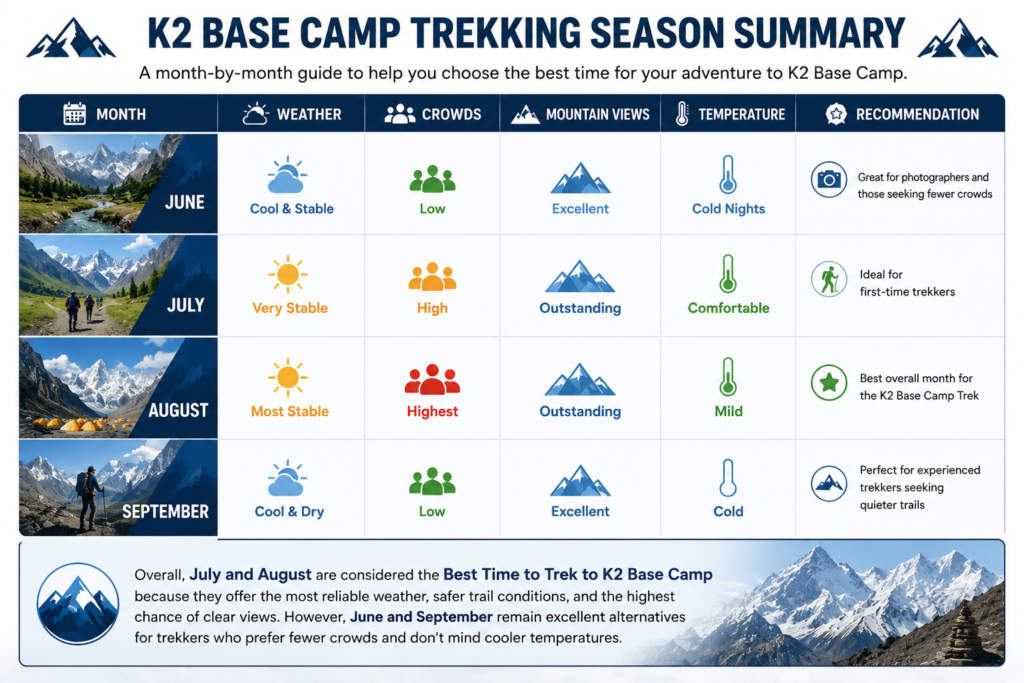
K2 Base Camp Trekking Season Summary
Month
Weather
Crowds
Mountain Views
Temperature
Recommendation
June
Cool & Stable
Low
Excellent
Cold Nights
Great for photographers and those seeking fewer crowds
July
Very Stable
High
Outstanding
Comfortable
Ideal for first-time trekkers
August
Most Stable
Highest
Outstanding
Mild
Best overall month for the K2 Base Camp Trek
September
Cool & Dry
Low
Excellent
Cold
Perfect for experienced trekkers seeking quieter trails
Overall, July and August are considered the Best Time to Trek to K2 Base Camp because they offer the most reliable weather, safer trail conditions, and the highest chance of clear views. However, June and September remain excellent alternatives for trekkers who prefer fewer crowds and don’t mind cooler temperatures.
Best-time-to-trek-to-k2-base-camp
Best Time to Trek to K2 Base Camp by Month
Every month during the trekking season offers a unique experience. Weather, temperatures, crowd levels, and trail conditions gradually change throughout the season, so understanding these differences can help you choose the departure that best matches your trekking goals.
Whether you’re looking for the clearest mountain views, the quietest trails, or the safest conditions for a first high-altitude expedition, this month-by-month guide will help you decide the Best Time to Trek to K2 Base Camp.
June
June marks the beginning of the official trekking season and is one of the most beautiful months to visit the Karakoram. Fresh snow still covers many of the surrounding peaks, creating breathtaking scenery along the Baltoro Glacier.
Although conditions are colder than later in the season, June rewards trekkers with peaceful campsites and outstanding photography opportunities.
Weather
Weather in June is generally stable, although occasional snowfall may still occur at higher elevations such as Concordia and K2 Base Camp. Days are usually sunny, while mornings and evenings remain cold.
Trekkers should be prepared for changing mountain weather, including sunshine, clouds, and strong winds.
Temperature
Approximate temperatures include:
Askole: 18–28°C
Paiyu: 10–18°C
Urdukas: 5–15°C
Goro II: -2–8°C
Concordia: -5–5°C
K2 Base Camp: -6–4°C
Advantages
Beautiful snow-covered scenery.
Very few trekkers.
Quiet campsites.
Excellent photography.
Cooler hiking temperatures.
Fresh glacier landscapes.
Disadvantages
Colder nights.
Possible snow at higher camps.
Slightly more difficult trail conditions.
Greater chance of Islamabad–Skardu flight delays early in the season.
Who Should Choose June?
June is ideal for:
Landscape photographers.
Experienced trekkers.
Travelers who dislike crowds.
Adventurers seeking dramatic mountain scenery.
July
July is one of the most popular months and is widely regarded as one of the Best Times to Trek to K2 Base Camp.
The trails are fully open, weather conditions are stable, and glacier crossings become easier as the snow melts.
Weather
July offers long sunny days with relatively stable mountain weather. Afternoon clouds occasionally develop, but mornings are often crystal clear, providing spectacular views of K2.
Temperature
Typical temperatures include:
Askole: 22–32°C
Paiyu: 14–22°C
Urdukas: 8–18°C
Goro II: 2–10°C
Concordia: 0–8°C
K2 Base Camp: -2–6°C
Advantages
Excellent weather stability.
Comfortable hiking temperatures.
Reliable trekking conditions.
Easier glacier crossings.
Outstanding mountain visibility.
Ideal for first-time trekkers.
Disadvantages
More trekkers.
Campsites can be busier.
Higher demand for flights and trekking permits.
August
August is often considered the absolute Best Time to Trek to K2 Base Camp.
Everything comes together during this month—stable weather, warm daytime temperatures, excellent mountain views, and well-established trekking routes.
Weather
August generally experiences the most consistent trekking weather. Although brief rain showers may occur in lower valleys, the upper Karakoram usually enjoys clear skies and comfortable hiking conditions.
Temperature
Typical temperatures include:
Askole: 20–30°C
Paiyu: 13–21°C
Urdukas: 8–17°C
Goro II: 1–9°C
Concordia: -1–7°C
K2 Base Camp: -2–5°C
Advantages
Most stable weather.
Excellent visibility.
Comfortable temperatures.
Best photography opportunities.
High success rate.
Suitable for all experience levels.
Disadvantages
Peak tourist season.
Busier campsites.
Flights and hotels book quickly.
Advance reservations are essential.
September
September is the final opportunity to complete the K2 Base Camp Trek before winter returns to the Karakoram.
While temperatures begin to drop, many trekkers believe September offers the clearest mountain views of the entire season.
Weather
Days remain pleasant for hiking, but nights become significantly colder. Snowfall becomes more likely toward the end of the month, particularly above 4,500 meters.
Temperature
Typical temperatures include:
Askole: 15–26°C
Paiyu: 8–18°C
Urdukas: 4–14°C
Goro II: -4–6°C
Concordia: -6–4°C
K2 Base Camp: -8–2°C
Advantages
Peaceful trekking experience.
Very few crowds.
Crystal-clear mountain views.
Beautiful autumn colors.
Excellent photography.
Disadvantages
Colder nights.
Higher chance of snowfall.
Shorter daylight hours.
End-of-season logistics may be more limited.
For trekkers who enjoy solitude and don’t mind colder conditions, September can be one of the most rewarding times to experience the Karakoram.
Final Recommendation
If you’re looking for the Best Time to Trek to K2 Base Camp based on overall weather, safety, and trail conditions:
🥇 August – Best overall choice for most trekkers.
🥈 July – Excellent for first-time trekkers and stable conditions.
🥉 June – Perfect for photographers and those seeking fewer crowds.
🏅 September – Ideal for experienced trekkers who want solitude and crystal-clear mountain views.
By choosing the month that best fits your experience level and travel goals, you’ll maximize your chances of enjoying a safe, memorable, and unforgettable K2 Base Camp Trek.
Weather on the K2 Base Camp Trek
One of the biggest factors when deciding the Best Time to Trek to K2 Base Camp is understanding the weather. The Karakoram Mountains are famous for their dramatic landscapes, but they are equally well known for unpredictable mountain weather. Conditions can change rapidly, and trekkers may experience sunshine, strong winds, freezing nights, and even occasional snowfall during the same expedition.
Although the official trekking season runs from June to September, weather varies depending on altitude, location, and time of day. Lower valleys such as Askole are relatively warm, while higher camps like Concordia and K2 Base Camp remain cold even during the middle of summer.
Preparing for these changing conditions is essential for a safe and enjoyable trek.
Day Temperature
During the trekking season, daytime temperatures are generally comfortable for hiking. At lower elevations, warm sunshine makes trekking pleasant, while higher camps remain cool because of their altitude.
Average daytime temperatures include:
Askole: 20°C to 30°C
Jhula: 18°C to 28°C
Paiyu: 15°C to 24°C
Urdukas: 10°C to 18°C
Goro II: 5°C to 10°C
Concordia: 3°C to 8°C
K2 Base Camp: 0°C to 6°C
The cooler temperatures at higher elevations are actually beneficial, making long hiking days more comfortable despite the physical effort. During sunny afternoons, however, the intense mountain sun can still cause dehydration and sunburn. Trekkers should always carry sunscreen, sunglasses, and sufficient drinking water.
Night Temperature
Nighttime temperatures are significantly colder than daytime temperatures and become one of the biggest challenges of the K2 Base Camp Trek.
As soon as the sun sets, temperatures drop rapidly, especially above 4,000 meters.
Typical nighttime temperatures include:
Askole: 10°C to 15°C
Jhula: 8°C to 12°C
Paiyu: 5°C to 10°C
Urdukas: 0°C to 5°C
Goro II: -5°C to 0°C
Concordia: -8°C to -3°C
K2 Base Camp: -10°C to -5°C
Even during July and August, frost is common at higher camps. A high-quality four-season sleeping bag, thermal clothing, insulated jacket, gloves, and warm socks are essential for staying comfortable during the expedition.
Snowfall
Although the Best Time to Trek to K2 Base Camp falls during the summer months, snowfall is still possible at higher elevations.
Fresh snow is most likely:
Early June.
Late September.
During occasional weather systems in July or August.
Light snowfall usually melts quickly during the day and rarely interrupts the trek. However, heavier snow may temporarily slow progress or require guides to adjust the route.
Snow-covered peaks also create some of the most spectacular scenery in the Karakoram, especially around Concordia and K2 Base Camp.
Rain
Rain is relatively uncommon on the Baltoro Glacier because the Karakoram lies within a dry mountain climate.
Most rainfall occurs in the lower valleys near Askole and Skardu.
Trekkers may experience:
Short afternoon showers.
Light rain in lower elevations.
Cloudy mornings after overnight rainfall.
Fortunately, heavy continuous rain is rare during the official trekking season.
Nevertheless, waterproof clothing should always be included in your packing list because mountain weather can change quickly.
Wind
Wind is another important factor when planning the Best Time to Trek to K2 Base Camp.
At higher elevations, especially on open glacier sections, strong winds are common.
Wind conditions typically become stronger:
During the afternoon.
Near Concordia.
Around Broad Peak Base Camp.
At K2 Base Camp.
Cold winds can make temperatures feel much lower than the actual reading. A good windproof shell jacket is one of the most important pieces of clothing for the expedition.
Visibility
Clear mountain views are one of the biggest reasons trekkers carefully choose the Best Time to Trek to K2 Base Camp.
Visibility is generally best:
Early in the morning.
After cold overnight temperatures.
During stable weather periods.
The clearest months are usually:
🥇 August
🥈 July
🥉 September
Excellent visibility allows trekkers to enjoy breathtaking views of:
K2.
Broad Peak.
Gasherbrum I.
Gasherbrum II.
Masherbrum.
Trango Towers.
Mitre Peak.
Marble Peak.
Photographers often wake before sunrise because the early morning light offers the clearest skies and the most dramatic views of the Karakoram.
Weather Summary
Although mountain weather can never be guaranteed, trekking between July and August generally provides the most stable conditions. June offers quieter trails and fresh snow, while September rewards trekkers with crisp air and exceptional visibility. Regardless of the month, proper clothing and preparation are essential for enjoying the Best Time to Trek to K2 Base Camp safely.
Temperature by Camp
Temperatures change dramatically throughout the K2 Base Camp Trek as you gradually climb from the village of Askole into the heart of the Karakoram. Each campsite has its own climate, and understanding these differences helps trekkers prepare the right clothing and equipment.
The table below provides approximate temperatures during the official trekking season (June–September). Actual conditions may vary depending on weather and altitude.
Camp
Altitude
Day Temperature
Night Temperature
Askole
3,040 m
20°C – 30°C
10°C – 15°C
Jhula
3,150 m
18°C – 28°C
8°C – 12°C
Paiyu
3,450 m
15°C – 24°C
5°C – 10°C
Urdukas
4,050 m
10°C – 18°C
0°C – 5°C
Goro II
4,300 m
5°C – 10°C
-5°C – 0°C
Concordia
4,691 m
3°C – 8°C
-8°C – -3°C
K2 Base Camp
5,150 m
0°C – 6°C
-10°C – -5°C
What These Temperatures Mean for Trekkers
As the trek progresses, temperatures steadily decrease while the effects of altitude become more noticeable. The first few days from Askole to Paiyu are generally warm enough for lightweight trekking clothes during the day, although evenings can still be cool.
From Urdukas onward, conditions become much colder. Trekkers usually switch to warmer layers, insulated jackets, gloves, and thermal clothing. Camps such as Goro II, Concordia, and K2 Base Camp regularly experience freezing nights, even in the middle of summer.
Because you’ll experience temperatures ranging from 30°C during the day to -10°C at night, dressing in layers is the most effective strategy. This allows you to adjust your clothing as conditions change throughout the day.
Understanding these temperature differences is another reason why careful planning is essential when choosing the Best Time to Trek to K2 Base Camp. Arriving with the proper clothing ensures you’ll stay comfortable, safe, and ready to enjoy one of the world’s greatest trekking adventures.
Which Month Has the Best Weather?
Choosing the Best Time to Trek to K2 Base Camp largely depends on the weather. While the official trekking season runs from June to September, not every month offers the same conditions. Differences in temperature, visibility, trail conditions, and crowd levels can significantly affect your overall trekking experience.
For most trekkers, July and August are considered the best months because they provide the most stable weather, comfortable daytime temperatures, excellent mountain visibility, and safer trail conditions. These months offer the highest chance of completing the expedition under ideal conditions.
Let’s take a closer look at why these two months stand out.
Why July Is One of the Best Months
July marks the beginning of the peak trekking season in the Karakoram. By this time, winter snow has mostly melted from the main trekking route, making the trails easier to navigate and reducing the risk of icy sections on the Baltoro Glacier.
Weather during July is generally stable, with warm days for trekking and cold but manageable nights at higher camps. Clear mornings often provide breathtaking views of K2, Broad Peak, Gasherbrum I & II, and the Trango Towers.
Another advantage of July is the longer daylight hours. Trekkers have more time to complete daily hikes at a comfortable pace while enjoying the spectacular scenery.
Advantages of Trekking in July
Stable mountain weather.
Comfortable daytime temperatures.
Clear views of K2 and surrounding peaks.
Safer glacier conditions.
Long daylight hours.
High success rate for expeditions.
Excellent month for first-time trekkers.
Things to Consider
Because July is one of the most popular months, expect:
Busier campsites.
Higher demand for domestic flights.
Earlier booking requirements.
More international trekking groups.
Despite these crowds, July remains one of the Best Times to Trek to K2 Base Camp, particularly for those seeking reliable weather and comfortable trekking conditions.
Why August Is Often Considered the Best Month
Many experienced guides and trekking operators consider August the absolute Best Time to Trek to K2 Base Camp.
By August, the trekking route is fully established, glacier crossings are generally at their safest, and weather conditions are usually at their most predictable.
Daytime temperatures are pleasant for hiking, while clear skies provide incredible panoramic views across the Karakoram Range. Sunrise and sunset over K2 are especially spectacular during this month, making August a favorite among photographers.
August also offers one of the highest chances of successfully reaching K2 Base Camp without major weather-related delays.
Advantages of Trekking in August
Most stable weather of the season.
Excellent mountain visibility.
Comfortable hiking temperatures.
Ideal glacier conditions.
Outstanding sunrise and sunset photography.
Highest probability of completing the trek successfully.
Things to Consider
Because August is the busiest month:
Flights to Skardu fill quickly.
Hotels in Skardu should be booked early.
Trekking permits should be arranged in advance.
Popular campsites become busier.
Even with these considerations, August remains the most recommended month for the majority of trekkers.
How Do June and September Compare?
Although July and August are considered the Best Time to Trek to K2 Base Camp, June and September also have their own advantages.
June
June offers:
Fresh snow on surrounding peaks.
Peaceful trails.
Cooler temperatures.
Beautiful glacier scenery.
However, higher camps may still experience occasional snowfall, and trail conditions can be slightly more challenging early in the month.
September
September is ideal for trekkers who prefer:
Fewer crowds.
Crystal-clear mountain views.
Cooler hiking temperatures.
Beautiful autumn colors.
The main disadvantage is colder nights and an increased possibility of snowfall toward the end of the month.
Our Recommendation
If you’re looking for the best overall experience, we recommend:
🥇 August – Best overall weather, visibility, and trekking conditions.
🥈 July – Excellent weather, ideal for first-time trekkers.
🥉 June – Best for photographers and quieter trails.
🏅 September – Perfect for experienced trekkers seeking solitude and dramatic autumn scenery.
For most people planning their first expedition, mid-July through mid-August is unquestionably the Best Time to Trek to K2 Base Camp.
Best Time for Photography
One of the biggest reasons people travel to Pakistan’s Karakoram Mountains is to capture some of the world’s most spectacular alpine landscapes. Towering 8,000-meter peaks, the vast Baltoro Glacier, dramatic granite towers, and the iconic summit of K2 create endless opportunities for unforgettable photographs.
If photography is one of your priorities, choosing the Best Time to Trek to K2 Base Camp becomes even more important. Weather, lighting, seasonal colors, and visibility all play a major role in the quality of your images.
Whether you’re using a professional camera, a drone (where permitted), or simply your smartphone, understanding the best lighting conditions will help you capture truly remarkable photographs.
Golden Light
Professional photographers often refer to the first hour after sunrise and the last hour before sunset as the Golden Hour.
During these periods, sunlight becomes softer and warmer, creating beautiful golden tones across the glaciers and mountain peaks.
Golden Hour is perfect for photographing:
K2.
Broad Peak.
Gasherbrum I & II.
Concordia.
Baltoro Glacier.
Trango Towers.
The warm light enhances textures in the rock and snow while creating dramatic shadows that add depth to your images.
Milky Way Photography
The Karakoram offers some of the darkest skies on Earth.
Because there is virtually no light pollution beyond Askole, trekkers have excellent opportunities to photograph the Milky Way.
The best locations include:
Paiyu Camp.
Urdukas.
Goro II.
Concordia.
K2 Base Camp.
Clear nights in July and August provide ideal conditions for astrophotography. On moonless nights, thousands of stars fill the sky, creating breathtaking images above K2 and the surrounding peaks.
A tripod and wide-angle lens are highly recommended for capturing the night sky.
Sunrise Photography
Sunrise is often considered the best time to photograph the Karakoram.
Early morning offers:
Crystal-clear air.
Minimal cloud cover.
Soft lighting.
Calm weather.
Excellent mountain visibility.
Watching the first rays of sunlight illuminate K2 from Concordia or K2 Base Camp is one of the most unforgettable experiences of the entire trek.
Many photographers wake before dawn to capture this magical moment.
Sunset Photography
Sunset transforms the mountains into brilliant shades of orange, gold, and pink.
As the sun drops behind the peaks, the surrounding glaciers reflect beautiful warm colors, creating dramatic landscapes.
Excellent sunset photography locations include:
Paiyu.
Urdukas.
Concordia.
K2 Base Camp.
Because winds often decrease during the evening, reflections and atmospheric conditions are sometimes even better than during the day.
Autumn Colors
Trekkers visiting during September enjoy an additional photographic advantage.
Lower valleys begin changing color as autumn arrives, creating beautiful contrasts between:
Golden trees.
Brown mountain slopes.
White glaciers.
Snow-covered peaks.
Deep blue skies.
These vibrant autumn landscapes provide a completely different atmosphere compared to the lush green scenery found earlier in the season.
For photographers seeking unique compositions, September offers some of the most visually striking landscapes of the entire trekking season.
Best Month for Photography
If your primary goal is photography, here’s our recommendation:
🥇 August – Best combination of stable weather, clear skies, and spectacular sunrise and sunset lighting.
🥈 July – Outstanding visibility, lush valleys, and long daylight hours.
🥉 September – Crystal-clear air, autumn colors, and fewer people in your photographs.
🏅 June – Fresh snow on the surrounding peaks creates dramatic mountain scenery with very few trekkers.
Final Thoughts
If photography is one of the main reasons you’re planning this adventure, timing your expedition carefully will make a huge difference. The Best Time to Trek to K2 Base Camp for photographers is generally late July through August, when stable weather, clear skies, and long daylight hours combine to create ideal shooting conditions. However, every month from June to September offers its own unique beauty, ensuring you’ll return home with unforgettable images of one of the world’s most spectacular mountain landscapes.
Best Time to Avoid Crowds
While July and August are considered the Best Time to Trek to K2 Base Camp because of their excellent weather, they are also the busiest months of the trekking season. Every year, hundreds of trekkers from around the world visit Pakistan during this period, making popular campsites such as Paiyu, Urdukas, Concordia, and K2 Base Camp much livelier.
If you prefer peaceful trails, quieter camps, and a more personal wilderness experience, you should consider trekking during the shoulder months of the season. These periods still offer excellent mountain scenery while allowing you to avoid the largest trekking groups.
Below are the best times to enjoy the K2 Base Camp Trek with fewer crowds.
Early June
Early June is one of the quietest times to begin the K2 Base Camp Trek. The trekking season has just started, so only a limited number of expeditions are operating.
This means you’ll experience:
Peaceful campsites.
Fewer trekkers on the Baltoro Glacier.
More opportunities for uninterrupted photography.
A greater sense of wilderness.
Easier interactions with local guides and support staff.
The surrounding mountains are often still covered with fresh snow, creating dramatic scenery that many photographers consider the most beautiful of the entire season.
However, trekkers should be prepared for:
Colder nights.
Occasional snowfall at higher camps.
Slightly more challenging trail conditions.
A higher chance of weather-related flight delays to Skardu.
Early June is an excellent choice for experienced trekkers, photographers, and anyone seeking a quieter adventure in the Karakoram.
Late August
Although August is generally the busiest month, the number of trekkers gradually decreases during the last two weeks of August.
Many international groups finish their expeditions before the end of the month, resulting in noticeably quieter trails while weather conditions remain highly favorable.
Advantages of trekking in late August include:
Stable weather.
Excellent mountain visibility.
Comfortable temperatures.
Fewer people at campsites.
Better opportunities for photography.
Easier bookings for hotels and flights.
For many trekkers, late August offers the perfect balance between ideal weather and reduced crowd levels, making it one of the smartest times to plan the K2 Base Camp Trek.
September
September is widely regarded as the quietest month of the official trekking season.
As temperatures begin to drop, visitor numbers decline significantly, leaving much of the Karakoram feeling peaceful and untouched.
During September you can enjoy:
Nearly empty trekking trails.
Quiet campsites.
Exceptional mountain visibility.
Crystal-clear skies.
Beautiful autumn colors in the lower valleys.
A true wilderness experience.
Many photographers consider September one of the best months because there are fewer people in landscape photographs, creating cleaner and more dramatic compositions.
The main disadvantages include:
Colder nights.
Shorter daylight hours.
Increased chance of snowfall toward the end of the month.
Despite these challenges, September remains one of the best choices for experienced trekkers looking for solitude.
Which Month Should You Choose to Avoid Crowds?
If your priority is experiencing the Karakoram with as few people as possible, here’s our recommendation:
🥇 September – Quietest month with spectacular mountain views.
🥈 Early June – Fresh snow, peaceful camps, and dramatic scenery.
🥉 Late August – Stable weather with noticeably fewer trekkers than mid-August.
Choosing one of these periods allows you to experience the beauty of the K2 Base Camp Trek without the larger crowds found during peak season.
Best Time for Beginners
For first-time high-altitude trekkers, choosing the Best Time to Trek to K2 Base Camp is especially important. Beginners benefit most from stable weather, well-established trails, comfortable temperatures, and reliable logistics.
Although the trekking season extends from June to September, the safest and most beginner-friendly period is generally mid-July to mid-August.
This four-week window consistently provides the most favorable conditions for completing the trek successfully.
Why Mid-July to Mid-August Is Ideal for Beginners
During this period, the Karakoram experiences its most stable weather of the year.
Trekkers can usually expect:
Warm and comfortable daytime temperatures.
Cold but manageable nights.
Fully established trekking routes.
Minimal snow on the trail.
Easier glacier crossings.
Excellent mountain visibility.
Longer daylight hours.
These conditions make daily hiking more comfortable and reduce many of the environmental challenges associated with the K2 Base Camp Trek.
Better Trail Conditions
By mid-July, the Baltoro Glacier route has been used by numerous trekking expeditions, making the trail easier to follow.
Compared with June or late September, beginners benefit from:
Less snow on the trail.
More stable glacier surfaces.
Easier river crossings.
Better-defined trekking paths.
Reduced risk of icy sections.
This allows first-time trekkers to focus on enjoying the scenery rather than worrying about difficult trail conditions.
More Reliable Weather
Mountain weather can never be completely predictable, but mid-July through mid-August generally offers the most consistent conditions.
Compared with other months, beginners are less likely to encounter:
Heavy snowfall.
Extremely cold nights.
Severe storms.
Frequent weather-related delays.
Stable weather not only improves comfort but also increases overall safety throughout the expedition.
Better Flight Reliability
One of the biggest logistical challenges of the K2 Base Camp Trek is traveling between Islamabad and Skardu.
Flights occasionally experience delays because of mountain weather.
During the peak season, especially in July and August, weather conditions are usually more favorable, improving the chances of successful flights.
Even so, experienced trekking companies always recommend including one or two buffer days in your itinerary to accommodate unexpected delays.
More Support on the Trail
Another advantage for beginners is that the peak season brings more trekking groups to the Karakoram.
This creates several benefits:
More experienced guides on the trail.
Better campsite organization.
Additional support if needed.
Easier communication between expedition teams.
Greater overall confidence for first-time trekkers.
Although the trails are busier than in June or September, many beginners appreciate the extra sense of security that comes with trekking during the busiest part of the season.
Why Beginners Should Avoid Early June and Late September
While June and September are beautiful months, they present additional challenges that may not be ideal for first-time trekkers.
Early June may include:
Snow-covered trails.
Colder temperatures.
More difficult glacier conditions.
Greater risk of flight delays.
Late September may involve:
Freezing nights.
Shorter daylight hours.
Fresh snowfall.
More unpredictable weather.
Experienced trekkers often enjoy these conditions, but beginners generally have a safer and more comfortable experience during the peak season.
Final Recommendation for Beginners
If this is your first high-altitude expedition, mid-July to mid-August is unquestionably the Best Time to Trek to K2 Base Camp.
During this period, you’ll benefit from:
The most stable weather.
Comfortable trekking temperatures.
Well-established trails.
Excellent mountain views.
Easier glacier crossings.
Better flight reliability.
High expedition success rates.
Greater support from experienced guides and trekking teams.
By choosing the right season and trekking with a professional local operator, even first-time trekkers can successfully complete one of the world’s most spectacular and rewarding adventures.
Best Time for Experienced Trekkers
While most first-time trekkers choose July or August, many experienced hikers prefer trekking during the shoulder months of June or September. These months offer a completely different experience, with quieter trails, dramatic landscapes, and a greater sense of wilderness.
Experienced trekkers are generally more comfortable dealing with colder temperatures, unpredictable weather, and changing trail conditions. As a result, they often prioritize solitude, photography, and adventure over perfect weather.
If you’ve completed several high-altitude treks before, you may find that June or September offers the most rewarding experience on the K2 Base Camp Trek.
Why Experienced Trekkers Choose June
June marks the beginning of the trekking season and offers a unique atmosphere that many seasoned adventurers appreciate.
One of the biggest attractions of June is the fresh snow that still covers many of the surrounding peaks. Combined with the massive Baltoro Glacier, this creates some of the most dramatic mountain scenery of the year.
Experienced trekkers often enjoy June because it provides:
Peaceful campsites.
Very few trekking groups.
Fresh snow on surrounding mountains.
Cooler daytime temperatures.
Excellent opportunities for landscape photography.
A stronger feeling of exploring untouched wilderness.
Although conditions are colder than July and August, experienced trekkers usually have the skills, equipment, and mindset to handle these challenges comfortably.
Why Experienced Trekkers Choose September
September offers an entirely different but equally rewarding experience.
As the trekking season comes to an end, the Karakoram becomes remarkably quiet. Many international expeditions have already finished, leaving the trails and campsites almost empty.
September offers:
Peaceful trekking routes.
Spectacular mountain visibility.
Crisp, dry air.
Beautiful autumn colors in the lower valleys.
Incredible sunrise and sunset photography.
A true wilderness experience.
Many professional photographers actually prefer September because the atmosphere is exceptionally clear, allowing distant peaks such as K2, Broad Peak, and the Gasherbrums to appear even sharper.
Greater Sense of Adventure
For experienced trekkers, the journey is often about more than simply reaching K2 Base Camp.
June and September provide a stronger expedition atmosphere because there are fewer people on the trail. Walking for hours across the Baltoro Glacier without seeing another trekking group creates a genuine feeling of exploration that many experienced hikers value.
This solitude allows trekkers to fully appreciate the immense scale of the Karakoram Mountains without the distractions of larger crowds.
Better Photography Opportunities
One of the biggest reasons experienced trekkers choose June or September is photography.
June Photography
June offers:
Fresh snow on surrounding peaks.
Bright white glaciers.
Vibrant green valleys.
Dramatic cloud formations.
Long daylight hours.
September Photography
September provides:
Crystal-clear mountain views.
Golden autumn colors.
Fewer people in photographs.
Rich sunrise and sunset colors.
Excellent night skies for astrophotography.
For photographers, both months offer unique conditions that are difficult to experience during the busier peak season.
Challenges Experienced Trekkers Should Expect
Although June and September are excellent choices, they also present additional challenges.
Trekkers should be prepared for:
Colder nights.
Greater chance of snowfall.
More unpredictable weather.
Shorter days in September.
Occasional flight delays.
Slightly more demanding trail conditions.
Experienced trekkers generally accept these conditions because they value the quieter environment and unique scenery.
Our Recommendation for Experienced Trekkers
If you’ve previously completed demanding high-altitude treks such as Everest Base Camp, Annapurna Circuit, or Kilimanjaro, you’ll likely enjoy trekking during the shoulder months.
Our recommendations are:
🥇 September – Best for solitude, crystal-clear views, and autumn landscapes.
🥈 June – Best for fresh snow, dramatic scenery, and peaceful camps.
🥉 July and August – Still excellent choices if you prefer the most stable weather.
Ultimately, the Best Time to Trek to K2 Base Camp depends on your personal preferences. Experienced trekkers often value solitude and scenery over perfect weather, making June and September particularly rewarding months.
Weather Challenges Throughout the Season
Although the Best Time to Trek to K2 Base Camp falls between June and September, trekkers should remember that the Karakoram Mountains remain one of the world’s most extreme environments.
Even during the official trekking season, weather can change rapidly. Sunshine may suddenly be replaced by clouds, strong winds, rain, or even snowfall.
Understanding these weather challenges will help you prepare properly and enjoy a safer expedition.
Cold Nights
Cold nights are one of the most consistent challenges throughout the K2 Base Camp Trek.
As you gain altitude, temperatures drop significantly after sunset.
Typical nighttime temperatures include:
Paiyu: 5°C to 10°C
Urdukas: 0°C to 5°C
Goro II: -5°C to 0°C
Concordia: -8°C to -3°C
K2 Base Camp: -10°C to -5°C
Even during the warmest months of July and August, freezing temperatures are common at higher camps.
To stay comfortable, trekkers should carry:
Four-season sleeping bag.
Thermal clothing.
Down jacket.
Wool socks.
Warm gloves.
Insulated hat.
Good-quality camping equipment supplied by experienced trekking companies also plays an important role in keeping trekkers warm throughout the expedition.
Rain
The Karakoram lies within a relatively dry mountain climate, so heavy rain is uncommon compared with other mountain regions.
However, occasional rain showers may occur, particularly in lower elevations such as:
Skardu.
Askole.
Jhula.
Paiyu.
Rain can make trails muddy during the early stages of the trek.
Fortunately, once trekkers reach the Baltoro Glacier, rainfall becomes much less frequent because of the colder, high-altitude environment.
Even so, every trekker should carry:
Waterproof jacket.
Waterproof trousers.
Backpack rain cover.
Waterproof gaiters (optional).
Being prepared for occasional rain ensures a much more comfortable trekking experience.
Snow
Many people are surprised to learn that snowfall is possible even during the official trekking season.
Light snowfall can occur:
Early June.
Late September.
Occasionally during storms in July or August.
Higher camps such as Goro II, Concordia, and K2 Base Camp are the most likely places to experience fresh snow.
While light snowfall often creates breathtaking scenery, heavier snowfall may slow progress or require itinerary adjustments.
Professional trekking guides continuously monitor weather conditions and always prioritize safety when planning daily hikes.
Wind
Strong mountain winds are another challenge of trekking in the Karakoram.
Wind speeds usually increase:
During the afternoon.
On exposed glacier sections.
Around Concordia.
Near K2 Base Camp.
Strong winds can make temperatures feel significantly colder than the actual reading.
To stay comfortable, trekkers should wear:
Windproof shell jacket.
Warm gloves.
Buff or neck gaiter.
Sunglasses to protect against blowing dust and ice particles.
Layering your clothing properly helps you adapt quickly as wind conditions change throughout the day.
Flight Delays
One of the most overlooked weather challenges is transportation.
Most K2 Base Camp Trek itineraries begin with a flight from Islamabad to Skardu. Because Skardu Airport is surrounded by high mountains, flights are highly dependent on favorable weather conditions.
Cloud cover, poor visibility, or strong winds can result in delays or cancellations.
For this reason, experienced trekking operators always recommend including one or two buffer days in your itinerary. These extra days provide flexibility in case of weather-related disruptions and help prevent unnecessary stress.
If flights are canceled, travelers usually continue the journey by road through the scenic Karakoram Highway, although this option requires significantly more travel time.
Final Thoughts
Although weather challenges are an unavoidable part of trekking in the Karakoram, they should not discourage you. With the right clothing, careful planning, experienced guides, and a flexible itinerary, these conditions can be managed safely.
Understanding seasonal weather patterns is one of the most important steps in choosing the Best Time to Trek to K2 Base Camp, ensuring you enjoy the incredible scenery while minimizing potential risks.
What to Pack for Each Month
Choosing the Best Time to Trek to K2 Base Camp is only half the preparation. Packing the right equipment for your chosen month is equally important.
Although the trekking season runs from June to September, weather conditions vary throughout the season. Early June is colder with occasional snowfall, July and August offer the most stable weather, and September brings cooler temperatures and crisp mountain air.
Regardless of when you trek, the K2 Base Camp Trek involves hiking from approximately 3,000 meters to over 5,100 meters, meaning you may experience temperatures ranging from 30°C during the day to below -10°C at night.
The best approach is to dress in layers, allowing you to adapt quickly to changing mountain weather.
Below is a month-by-month packing guide.
June Packing List
June marks the beginning of the trekking season, and temperatures remain colder than in later months. Fresh snow may still be present around Concordia and K2 Base Camp, so trekkers should pack extra warm clothing.
Clothing
Waterproof shell jacket
Waterproof trekking trousers
Down jacket (recommended -10°C)
Fleece jacket
Thermal base layers (2–3 sets)
Moisture-wicking trekking shirts
Trekking trousers
Warm hiking socks (4–5 pairs)
Wool socks for sleeping
Warm beanie
Sun hat
Buff or neck gaiter
Lightweight gloves
Insulated winter gloves
Footwear
Waterproof trekking boots
Camp shoes or sandals
Gaiters (recommended in June)
Sleeping Equipment
Four-season sleeping bag (-15°C comfort rating)
Sleeping bag liner
Inflatable pillow (optional)
Accessories
Trekking poles
Sunglasses (Category 3 or 4)
Sunscreen SPF 50+
Lip balm with SPF
Headlamp with spare batteries
Power bank
Reusable water bottles
Hydration bladder (optional)
Why Pack Extra Warm Gear?
Because June can still experience snowfall and freezing temperatures at higher camps, extra insulation provides greater comfort and safety throughout the expedition.
July Packing List
July is one of the Best Times to Trek to K2 Base Camp, thanks to stable weather and comfortable hiking conditions. Although daytime temperatures are warmer, freezing nights are still common above 4,000 meters.
Clothing
Lightweight waterproof jacket
Down jacket
Lightweight fleece
Moisture-wicking T-shirts
Trekking trousers
Thermal leggings
Hiking socks
Warm sleeping socks
Sun hat
Beanie
Lightweight gloves
Footwear
Waterproof trekking boots
Comfortable camp shoes
Sleeping Equipment
Four-season sleeping bag
Sleeping bag liner
Accessories
Trekking poles
Sunglasses
Sunscreen
Headlamp
Camera equipment
Power bank
Personal first aid kit
Why July Is Easier to Pack For
Compared to June, July usually requires fewer heavy winter layers. However, warm clothing remains essential for nights at Concordia and K2 Base Camp.
August Packing List
August is widely regarded as the Best Time to Trek to K2 Base Camp, offering excellent weather and comfortable trekking temperatures.
Packing requirements are similar to July.
Clothing
Waterproof shell jacket
Lightweight insulated jacket
Down jacket
Fleece layer
Trekking shirts
Trekking trousers
Thermal base layers
Warm socks
Gloves
Hat
Neck buff
Equipment
Waterproof trekking boots
Trekking poles
Four-season sleeping bag
Sunglasses
Sunscreen
Camera
Power banks
Water purification tablets (optional)
Why August Is Ideal
Stable weather means less bulky clothing is needed during daytime hikes, although warm gear remains necessary for evenings and mornings.
September Packing List
September marks the end of the trekking season, and temperatures begin to fall rapidly, especially after sunset.
Trekkers should prepare for colder weather than in July or August.
Clothing
Heavy down jacket
Waterproof shell jacket
Warm fleece
Multiple thermal layers
Insulated gloves
Warm beanie
Neck gaiter
Extra wool socks
Waterproof trekking trousers
Equipment
Four-season sleeping bag
Trekking poles
Waterproof backpack cover
Headlamp
Hand warmers (optional)
Thermos flask (recommended)
Why September Requires Extra Warm Clothing
Although daytime hiking remains comfortable, nighttime temperatures at K2 Base Camp frequently fall well below freezing. Packing additional warm layers makes the expedition significantly more comfortable.
Essential Items for Every Month
Regardless of the month you choose, every trekker should bring:
Passport and permits
Personal medications
Water bottles
Water purification tablets
Sunscreen SPF 50+
Sunglasses
Trekking poles
Four-season sleeping bag
Waterproof trekking boots
Warm clothing
Headlamp
Power bank
Camera
Personal toiletries
Snacks and energy bars
Packing appropriately for your chosen month ensures you’ll be comfortable, safe, and fully prepared to enjoy the Best Time to Trek to K2 Base Camp.
Common Mistakes When Choosing Trek Dates
Choosing the Best Time to Trek to K2 Base Camp is one of the most important decisions you’ll make. Every year, some trekkers encounter avoidable problems simply because they underestimate the seasonal conditions or fail to plan ahead.
Understanding these common mistakes will help you avoid unnecessary stress and increase your chances of completing the trek successfully.
Choosing Too Early in the Season
Some trekkers book departures in very early June, assuming that summer conditions have already arrived.
In reality, higher sections of the Baltoro Glacier may still have:
Fresh snow.
Slippery terrain.
Colder temperatures.
Less predictable weather.
Although June is an excellent month for experienced trekkers and photographers, beginners may find mid-July to mid-August more comfortable.
Ignoring Flight Delays
One of the most common planning mistakes is booking international flights with no flexibility.
Flights between Islamabad and Skardu are highly dependent on mountain weather.
Poor visibility, cloud cover, or strong winds may cause delays or cancellations.
To avoid unnecessary stress, always include:
1–2 buffer days before the trek.
1–2 buffer days after the trek.
These extra days protect your international travel plans if weather affects domestic flights.
Packing for Summer Instead of High Altitude
Many first-time visitors assume that trekking during July or August means warm weather throughout the journey.
While daytime temperatures can be pleasant, nights at Concordia and K2 Base Camp regularly fall below freezing.
Packing only lightweight summer clothing can lead to:
Cold nights.
Poor sleep.
Increased fatigue.
Higher risk of cold-related illness.
Always prepare for alpine conditions, regardless of the month.
Not Allowing Buffer Days
Another common mistake is planning an itinerary that’s too tight.
Mountain weather is unpredictable, and transport schedules can change without warning.
Adding extra days allows for:
Flight delays.
Road closures.
Weather-related itinerary changes.
Better acclimatization.
A more relaxed travel experience.
Most experienced trekking companies include buffer days because flexibility is essential in the Karakoram.
Booking Too Late
Because the Best Time to Trek to K2 Base Camp is limited to a short season, demand is highest during July and August.
Last-minute bookings often result in:
Higher flight prices.
Limited hotel availability.
Fewer trekking departure options.
Increased equipment rental costs.
Booking your trek 6–9 months in advance gives you the best selection of departure dates and often better prices.
Following the Lowest Price Instead of the Best Operator
Some trekkers choose the cheapest available package without considering the quality of the services included.
A reputable operator should provide:
Licensed local guides.
Experienced support staff.
High-quality camping equipment.
Proper acclimatization itinerary.
Emergency communication equipment.
Transparent pricing with no hidden charges.
Choosing an experienced trekking company is far more important than saving a small amount of money.
Ignoring Personal Fitness
Another mistake is selecting the peak trekking season but arriving without adequate preparation.
Even during the Best Time to Trek to K2 Base Camp, the trek remains physically demanding.
A good training program should begin at least three months before departure and include:
Cardio workouts.
Strength training.
Long-distance hiking.
Stair climbing.
Flexibility exercises.
Good fitness improves safety, comfort, and enjoyment throughout the expedition.
Final Thoughts
Choosing the right dates is about more than finding good weather—it’s about giving yourself the best possible chance of enjoying a safe, comfortable, and unforgettable adventure.
By avoiding these common mistakes, booking early, preparing properly, and trekking with an experienced operator, you’ll maximize your experience during the Best Time to Trek to K2 Base Camp and create memories that will last a lifetime.
Frequently Asked Questions
Is July the Best Time to Trek to K2 Base Camp?
Yes, July is one of the Best Times to Trek to K2 Base Camp because the weather is generally stable, the Baltoro Glacier is fully accessible, and mountain views are outstanding. It is also ideal for first-time trekkers thanks to comfortable daytime temperatures and well-established trekking routes. The only downside is that July is one of the busiest months of the season.
Is August Better Than July for the K2 Base Camp Trek?
Both months offer excellent conditions, but many experienced guides consider August the overall Best Time to Trek to K2 Base Camp. August usually has the most stable weather, comfortable temperatures, and excellent visibility. If you don’t mind larger crowds, August provides one of the highest chances of completing the trek successfully.
Can You Trek to K2 Base Camp in May?
No. May is generally not recommended because the trekking season has not officially started. Heavy snow, blocked sections of the Baltoro Glacier, freezing temperatures, and limited logistical support make trekking difficult and potentially unsafe.
Is September Too Cold for the K2 Base Camp Trek?
Not at all. September remains an excellent month for trekking. While nights become much colder—often dropping below -10°C at higher camps—daytime hiking conditions are still comfortable. September is perfect for experienced trekkers who prefer quieter trails, crystal-clear mountain views, and beautiful autumn scenery.
Does It Rain on the Baltoro Glacier?
Rain is relatively rare on the Baltoro Glacier due to the dry climate of the Karakoram Mountains. However, light rain may occur at lower elevations such as Askole or Paiyu. At higher altitudes, precipitation is more likely to fall as snow rather than rain.
Is July Crowded?
Yes. July is one of the busiest months for the K2 Base Camp Trek. Most international trekking groups schedule their departures during this period because of the stable weather and favorable trail conditions. If you prefer fewer people, consider trekking in early June or September.
Which Month Has the Clearest Views of K2?
August generally offers the clearest mountain views due to stable weather and low atmospheric moisture. September is also excellent, with crisp air providing exceptional long-distance visibility. Early mornings in both months are often the best time to see K2 in all its glory
What Is the Warmest Month on the K2 Base Camp Trek?
July and August are the warmest months during the trekking season. Daytime temperatures at lower elevations can reach 25–30°C, while higher camps remain cool. Even during these months, nighttime temperatures at K2 Base Camp frequently fall below freezing.
Can Beginners Trek to K2 Base Camp in June?
Yes, but it depends on fitness and experience. Early June can be colder, with occasional snowfall and more challenging trail conditions. Most beginners are better suited to trekking between mid-July and mid-August, when weather conditions are more stable and the route is fully established.
Which Month Is Best for Photography?
For photography, August is generally considered the best month thanks to stable weather, long daylight hours, and dramatic sunrise and sunset lighting. June offers fresh snow on the surrounding peaks, while September provides crystal-clear skies and stunning autumn colors, making all three months excellent choices for photographers.
How Cold Does It Get at K2 Base Camp?
During the trekking season, nighttime temperatures at K2 Base Camp (5,150 m) typically range from -5°C to -10°C. In June and September, temperatures can occasionally fall even lower. A high-quality four-season sleeping bag and warm layered clothing are essential for staying comfortable.
What Happens If Flights to Skardu Are Canceled?
Flights between Islamabad and Skardu are weather-dependent. If a flight is canceled, most trekking operators arrange travel by road via the Karakoram Highway, although the journey takes considerably longer. This is why it is strongly recommended to include one or two buffer days in your itinerary before and after the trek.
Ready to Trek to K2 Base Camp?
The Best Time to Trek to K2 Base Camp is short, and the most popular departures between June and September often fill months in advance. Whether you’re planning your first high-altitude adventure or returning to explore the spectacular Karakoram once again, choosing the right trekking company makes all the difference.
At Trek to K2 Base Camp, we specialize in professionally organized expeditions that combine safety, local expertise, and unforgettable mountain experiences. Our itineraries are carefully designed to maximize acclimatization, increase summit success, and provide a comfortable trekking experience from start to finish.
Why Trek With Us?
✅ Fixed departures from June to September
✅ Experienced local Balti guides with extensive Karakoram knowledge
✅ Carefully planned acclimatization itinerary for safer trekking
✅ Small group sizes for a more personalized experience
✅ Professional logistics, camping equipment, and support staff
✅ Transparent pricing with no hidden costs
✅ Airport transfers and complete expedition management
✅ 24/7 expert support before and during your adventure
✅ Years of experience leading successful treks in the Karakoram
Whether you choose June, July, August, or September, we’ll help you select the Best Time to Trek to K2 Base Camp based on your experience, fitness level, and travel goals.