The K2 Base Camp Trek Guide is one of the world’s most spectacular trekking adventures, taking you through the heart of Pakistan’s Karakoram Mountains. This complete guide covers everything you need to know, including the best time to visit, itinerary, cost, permits, fitness requirements, packing list, altitude, accommodation, safety, and expert travel tips for 2026.
The K2 Base Camp is located in the remote Karakoram Mountain Range of Gilgit-Baltistan, Pakistan, at an altitude of approximately 5,150 meters (16,896 feet) above sea level. It lies at the foot of K2 (8,611m), the world’s second-highest mountain and one of the most challenging peaks to climb.
Reaching K2 Base Camp is an adventure in itself. The journey begins in Skardu, the gateway to the Karakoram, followed by a scenic drive to Askole, the last permanent village before the trek. From Askole, trekkers spend several days walking across the spectacular Baltoro Glacier, one of the longest glaciers outside the polar regions, passing famous campsites such as Jhula, Paiyu, Urdukas, Goro II, and the legendary Concordia.
Concordia is often referred to as the “Throne Room of the Mountain Gods” because it is surrounded by some of the world’s highest peaks, including K2, Broad Peak, Gasherbrum I, Gasherbrum II, and several other magnificent summits. From Concordia, a final trek across the Godwin-Austen Glacier leads to K2 Base Camp, where trekkers are rewarded with breathtaking views of the mighty K2 towering directly above.
Unlike many popular trekking destinations, K2 Base Camp remains wild, untouched, and far from commercial tourism, offering an authentic high-altitude adventure in one of the most spectacular mountain landscapes on Earth.
Why Trek to K2 Base Camp?
The K2 Base Camp Trek is widely regarded as one of the world’s greatest trekking adventures, offering an unforgettable journey through the heart of the Karakoram Mountains. Unlike many crowded trekking routes, this expedition takes you into one of the most remote and untouched wilderness areas on the planet, where towering peaks, massive glaciers, and dramatic landscapes create an experience unlike any other.
One of the biggest highlights of the trek is walking across the legendary Baltoro Glacier, a spectacular river of ice stretching for over 60 kilometers. Along the route, you’ll be surrounded by iconic granite towers, snow-covered summits, and breathtaking valleys that have inspired climbers and explorers for generations.
The trek also leads to Concordia, often called the “Throne Room of the Mountain Gods.” From this remarkable viewpoint, you can witness one of the greatest mountain panoramas on Earth, with four of the world’s highest peaks visible in a single location, including K2 (8,611m), Broad Peak (8,051m), Gasherbrum I (8,080m), and Gasherbrum II (8,035m).
Beyond the stunning scenery, the journey offers an opportunity to experience the rich culture and warm hospitality of the Balti people, who have lived in this rugged mountain region for centuries. Every campsite brings a new perspective of the Karakoram, from lush green valleys near Askole to the icy landscapes surrounding K2 Base Camp.
Whether you’re an experienced trekker, passionate photographer, nature enthusiast, or adventure traveler, the K2 Base Camp Trek delivers a once-in-a-lifetime experience that combines physical challenge, natural beauty, and genuine exploration.
🌟 Trek Highlights
Witness the world’s second-highest mountain, K2 (8,611m), from its iconic Base Camp.
Trek across the breathtaking Baltoro Glacier, one of the longest non-polar glaciers in the world.
Visit the legendary Concordia, often called the Throne Room of the Mountain Gods.
Enjoy spectacular views of Broad Peak, Gasherbrum I, Gasherbrum II, Masherbrum, and the famous Trango Towers.
Experience the authentic culture and hospitality of the local Balti communities.
Camp beneath some of the world’s most dramatic mountain scenery.
Explore one of the last truly remote trekking destinations on Earth.
Capture unforgettable sunrise and sunset views over the Karakoram’s snow-covered peaks.
Best Time to Visit K2 Base Camp
The best time to visit K2 Base Camp is from late June to early September, when the Karakoram trekking season is at its peak. During these months, the weather is relatively stable, mountain passes are free from heavy snow, and the Baltoro Glacier is accessible for trekking. Although weather in the high mountains can change rapidly, this period offers the safest and most comfortable conditions for reaching K2 Base Camp.
July and August are considered the peak trekking months. The days are generally warmer at lower elevations, while nights remain cold, especially above 4,000 meters. During this period, trekkers enjoy clear mountain views, longer daylight hours, and the highest chances of successfully reaching K2 Base Camp and Concordia.
Late June and early September are also excellent choices for those who prefer quieter trails. There are fewer trekking groups, and the landscapes remain spectacular. However, temperatures are slightly lower, particularly during the night, so proper cold-weather clothing is essential.
Winter and early spring are not suitable for trekking to K2 Base Camp due to heavy snowfall, closed routes, extreme temperatures, and a high risk of avalanches. Most trekking companies do not operate expeditions outside the summer trekking season.
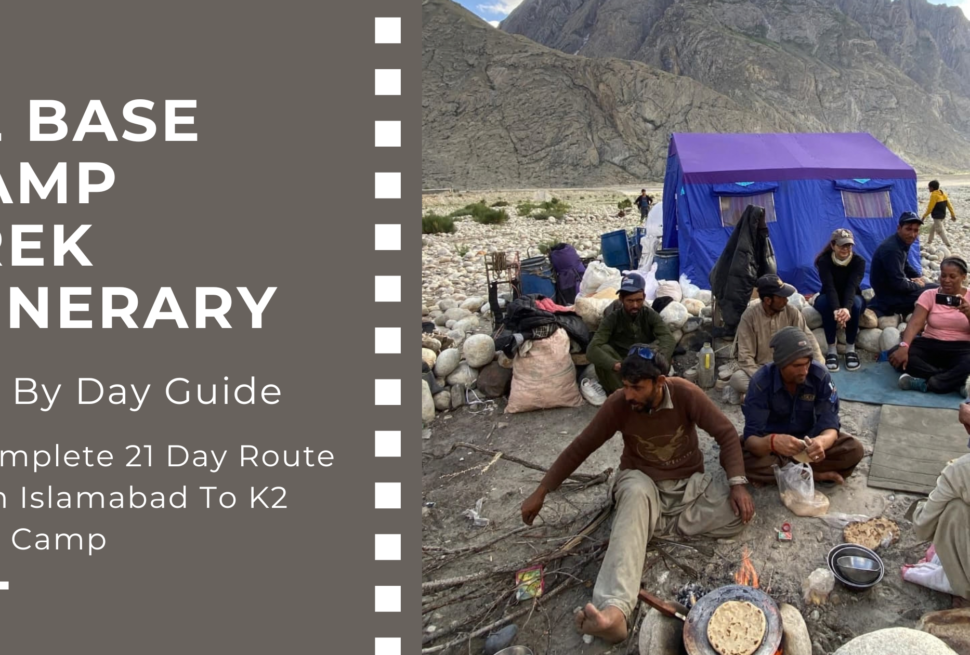
A standard K2 Base Camp Trek typically takes 14 to 21 days, depending on your itinerary, acclimatization schedule, and travel arrangements. The journey begins in Islamabad, followed by a flight or drive to Skardu, the gateway to the Karakoram Mountains. After a scenic jeep drive to Askole, the last permanent village on the route, the real adventure begins.
Trekkers follow the historic Baltoro Glacier, passing through spectacular campsites such as Jhula, Paiyu, Khoburtse, Urdukas, and Goro II before reaching the breathtaking amphitheater of Concordia. From Concordia, the trail continues across the Godwin-Austen Glacier to the legendary K2 Base Camp, where trekkers stand beneath the world’s second-highest mountain.
After spending time at K2 Base Camp, most groups return via the same route to Askole before driving back to Skardu. Some experienced trekkers choose the more challenging Gondogoro La Pass, which offers a spectacular circular route and panoramic views of four 8,000-meter peaks.
Sample 14-Day Trekking Itinerary
Day
Route
Day 1
Arrive in Skardu and prepare for the trek.
Day 2
Drive from Skardu to Askole.
Day 3
Trek from Askole to Jhula.
Day 4
Trek from Jhula to Paiyu.
Day 5
Trek from Paiyu to Khoburtse.
Day 6
Trek from Khoburtse to Urdukas.
Day 7
Trek from Urdukas to Goro II.
Day 8
Trek from Goro II to Concordia.
Day 9
Day hike to K2 Base Camp and return to Concordia or Goro II (depending on the itinerary).
Day 10
Trek back towards Goro II or Urdukas.
Day 11
Continue trekking to Paiyu.
Day 12
Trek from Paiyu to Askole.
Day 13
Drive back to Skardu.
Day 14
Departure from Skardu or onward travel.
💡 Note: Many international itineraries are 18–21 days because they include arrival in Islamabad, flights to Skardu, acclimatization days, and weather contingency days. The actual trekking portion from Askole to K2 Base Camp and back is usually 12–14 days.
K2 Base Camp Trek Difficulty
The K2 Base Camp Trek is considered a challenging to strenuous high-altitude trek. While it does not require technical climbing skills or mountaineering experience, it demands excellent physical fitness, mental endurance, and the ability to trek for long hours over rugged terrain.
Unlike shorter trekking routes, the K2 Base Camp Trek involves walking for 6 to 9 hours per day across rocky trails, glacier moraines, river crossings, and uneven mountain paths. As the trek progresses, the altitude increases gradually, making every day more physically demanding.
One of the biggest challenges is trekking on the Baltoro Glacier, where the trail consists of loose rocks, ice, and moraine rather than well-defined mountain paths. The high altitude also means there is less oxygen available, making even simple activities more tiring than at sea level.
Weather conditions in the Karakoram can change rapidly. Even during the summer trekking season, trekkers may experience warm sunshine during the day followed by freezing temperatures, snowfall, or strong winds at higher camps. Proper preparation and following your guide’s instructions are essential for a safe and enjoyable experience.
Although the trek is demanding, thousands of adventure travelers successfully complete it every year with the right preparation, a gradual pace, and proper acclimatization. The route is designed to allow your body to adapt to the increasing altitude, significantly reducing the risk of altitude-related illness.
Why is the K2 Base Camp Trek Challenging?
High altitude reaching 5,150 meters (16,896 ft).
Daily trekking of 6–9 hours over long distances.
Rocky trails, glacier moraines, and uneven terrain.
Limited facilities in remote mountain camps.
Cold temperatures, especially during the night.
Rapid weather changes in the Karakoram Mountains.
Several days without road access or modern infrastructure.
Who Can Complete This Trek?
The K2 Base Camp Trek is suitable for:
Experienced trekkers looking for a world-class adventure.
Active hikers with good physical fitness.
Adventure travelers prepared for high-altitude trekking.
Beginners who have trained properly and are joining a professional guided expedition.
Previous trekking experience is helpful but not mandatory. Many first-time high-altitude trekkers successfully complete the journey each year after following a structured fitness program and trekking with an experienced local guide.
💡 Expert Tip: The biggest challenge is not the distance—it’s maintaining your energy and adapting to the altitude. Walking at a steady pace, staying hydrated, and following your guide’s advice are the keys to a successful trek.
Preparing your body before the trek is one of the most important factors in ensuring a safe and enjoyable experience. While you do not need to be an elite athlete, you should have a good level of cardiovascular fitness, leg strength, and endurance before attempting the K2 Base Camp Trek.
Since you will be trekking for multiple consecutive days while carrying a small daypack, your body should be comfortable walking on steep and uneven terrain for several hours without excessive fatigue. The better your fitness level, the more you will enjoy the spectacular scenery instead of struggling with the physical demands of the trek.
Ideally, you should begin training at least 8 to 12 weeks before your departure. Focus on improving your endurance, strengthening your legs and core, and gradually increasing the duration of your hikes. If possible, practice hiking with a backpack on hills or staircases to simulate mountain conditions.
Remember that no amount of fitness completely eliminates the effects of high altitude. Acclimatization, proper hydration, sufficient rest, and following your guide’s pace remain essential throughout the trek.
Recommended Training Before the Trek
To prepare for the K2 Base Camp Trek, include the following activities in your training routine:
Hiking on hills or mountain trails.
Long-distance walking (10–20 km).
Stair climbing with a light backpack.
Running, cycling, or swimming to improve cardiovascular endurance.
Strength training for the legs and core.
Stretching and mobility exercises to reduce the risk of injury.
Aim to exercise 4–5 times per week, gradually increasing the intensity as your trek approaches.
Minimum Fitness Checklist
Before joining the trek, you should ideally be able to:
Fitness Goal
Recommendation
Walking
15–20 km comfortably in a day
Hiking
6–8 hours on uneven terrain
Stair Climbing
30–45 minutes continuously
Backpack
Carry a 5–8 kg daypack comfortably
Cardio
45–60 minutes of moderate exercise without difficulty
Can Beginners Join the K2 Base Camp Trek?
Yes. Beginners with a good fitness level and proper preparation can successfully complete the K2 Base Camp Trek. Many participants have no previous high-altitude trekking experience but complete the journey safely by training in advance, trekking at a steady pace, and joining a professional guided expedition.
If this is your first major mountain trek, it is recommended to start your fitness training several months in advance and consult your doctor if you have any underlying medical conditions.
💡 Expert Tip: Consistency is more important than intensity. Training regularly for a few months before the trek is far more effective than trying to get fit in the last couple of weeks
Altitude on the K2 Base Camp Trek
The K2 Base Camp Trek reaches a maximum altitude of approximately 5,150 meters (16,896 feet) above sea level. While this is lower than the summit of K2 itself, it is still considered a high-altitude trekking destination where the reduced oxygen levels can significantly affect your body.
The journey begins in Skardu (2,230 m) and gradually gains elevation over several days, allowing trekkers to acclimatize naturally before reaching higher camps. This gradual ascent is one of the reasons why most trekkers successfully complete the expedition without serious altitude-related problems.
As you climb higher into the Karakoram, the air becomes thinner, meaning there is less oxygen available. It is completely normal to experience mild symptoms such as shortness of breath, fatigue, or a slight headache during the first few days at higher elevations. Walking slowly, drinking plenty of water, eating well, and following your guide’s pace are the best ways to help your body adjust.
Professional trekking itineraries include carefully planned acclimatization, ensuring that trekkers gain altitude gradually rather than too quickly. This significantly reduces the risk of Acute Mountain Sickness (AMS) and helps improve overall safety throughout the expedition.
Although serious altitude sickness is uncommon among well-prepared trekkers following a proper itinerary, everyone reacts differently to high altitude. For this reason, it is important to listen to your body and immediately inform your guide if you experience persistent headaches, dizziness, nausea, or unusual fatigue.
Altitude Profile
Location
Altitude
Islamabad
540 m
Skardu
2,230 m
Askole
3,040 m
Jhula
3,200 m
Paiyu
3,450 m
Khoburtse
3,930 m
Urdukas
4,050 m
Goro II
4,300 m
Concordia
4,691 m
K2 Base Camp
5,150 m
How to Prevent Altitude Sickness
To reduce the risk of altitude sickness during the K2 Base Camp Trek:
Trek at a slow and steady pace.
Drink at least 3–4 liters of water each day.
Avoid alcohol and smoking during the expedition.
Eat regular, high-energy meals.
Get enough rest every night.
Follow your guide’s instructions and never rush the ascent.
Inform your guide immediately if you develop symptoms of AMS.
💡 Expert Tip: Altitude affects everyone differently, regardless of age or fitness level. The safest approach is to hike slowly, stay hydrated, and allow your body enough time to acclimatize naturally.
Accommodation on the K2 Base Camp Trek
Accommodation during the K2 Base Camp Trek combines comfortable hotels before and after the trek with fully supported camping in the mountains. This allows trekkers to enjoy modern facilities in Skardu while experiencing the true wilderness of the Karakoram during the expedition.
Before the trek begins, guests typically stay in comfortable hotels in Skardu, where private rooms, hot showers, Wi-Fi, and restaurants are available. This is also the best opportunity to relax, organize equipment, and make final preparations before entering the remote mountain region.
Once the trek starts from Askole, accommodation is entirely in high-quality mountain tents at designated campsites. Each campsite is carefully selected for safety, water availability, and spectacular scenery. Depending on the itinerary, camps are usually established at Jhula, Paiyu, Khoburtse, Urdukas, Goro II, Concordia, and K2 Base Camp.
Most professional trekking companies provide spacious two-person sleeping tents, a separate dining tent, kitchen tent, and toilet tent. The support staff, including guides, cooks, and porters, handle camp setup and meal preparation, allowing trekkers to focus entirely on the adventure.
Camping in the Karakoram offers a unique opportunity to spend each night surrounded by glaciers and towering peaks under some of the clearest night skies in the world. While facilities are basic compared to hotels, the experience is unforgettable and forms an essential part of the K2 Base Camp adventure.
Accommodation Overview
Location
Accommodation
Skardu
Comfortable Hotel
Askole
Basic Guesthouse or Camping (depending on itinerary)
Jhula
Camping
Paiyu
Camping
Khoburtse
Camping
Urdukas
Camping
Goro II
Camping
Concordia
Camping
K2 Base Camp
Camping
What Facilities Are Available?
Accommodation during the trek generally includes:
Comfortable twin-sharing mountain tents.
Foam sleeping mattress (sleeping bag usually brought by the trekker or provided, depending on the package).
Large dining tent with tables and chairs.
Kitchen tent managed by experienced cooks.
Freshly prepared meals every day.
Safe drinking water after purification.
Hot showers are available in Skardu hotels before and after the trek. In Askole, hot water may sometimes be available, but hot showers are not guaranteed. Beyond Askole, hot showers are generally not available due to the remote mountain environment. However, if needed, hot water can usually be provided in a bucket for basic washing at most camps, depending on fuel availability and weather conditions.
Electricity is available in Skardu, and charging facilities may be available in Askole, but they are not guaranteed. Once the trek begins, there are no reliable charging facilities. Trekkers are strongly advised to carry high-capacity power banks or solar chargers to keep essential devices powered throughout the expedition.
💡 Expert Tip: Bring a high-quality sleeping bag rated for sub-zero temperatures, as nights at higher camps such as Goro II, Concordia, and K2 Base Camp can be extremely cold, even during the peak trekking season.
Food on the K2 Base Camp Trek
One of the most common concerns among trekkers is the availability and quality of food during the K2 Base Camp Trek. Although the trek takes place in one of the world’s most remote mountain regions, professional trekking expeditions provide freshly prepared, nutritious, and energy-rich meals throughout the journey.
Before the trek begins, guests enjoy meals at their hotel in Skardu, where a wide variety of Pakistani and continental dishes are available. Once the expedition starts from Askole, all meals are prepared by the trekking team’s experienced mountain cooks using fresh ingredients carried by porters and support staff.
The menu is designed to provide the calories and nutrients needed for long days of trekking at high altitude. Meals are simple, hygienic, and filling, helping trekkers maintain their energy levels throughout the expedition.
Breakfast is usually served early in the morning before trekking begins, followed by a packed or freshly prepared lunch along the trail. In the evening, trekkers gather in the dining tent for a hot dinner, where they can relax, enjoy warm meals, and prepare for the next day’s adventure.
Special dietary requirements, including vegetarian, vegan, and gluten-free meals, can often be arranged if requested in advance when booking your trek.
Typical Daily Menu
Breakfast
Eggs (fried, boiled, or omelet)
Bread, chapati, or toast
Jam, butter, and honey
Porridge or cereal
Tea, coffee, and hot chocolate
Lunch
Rice or pasta
Chicken or vegetable curry
Fresh salad (when available)
Seasonal fruit
Biscuits and snacks
Dinner
Soup
Rice, pasta, or noodles
Chicken, beef, lentils, or vegetable dishes
Fresh vegetables (when available)
Tea or hot drinks
Drinking Water
Safe drinking water is essential during the trek. Water is collected from natural mountain streams and glacier-fed sources before being boiled, filtered, or purified by the trekking staff.
Trekkers are encouraged to carry a reusable water bottle or hydration bladder and drink 3–4 liters of water each day to stay properly hydrated at high altitude.
Can I Bring My Own Snacks?
Yes. While meals are provided throughout the trek, many trekkers prefer to bring their favorite energy snacks for extra fuel during long hiking days.
Popular snacks include:
Energy bars
Chocolate
Mixed nuts
Dates
Dried fruits
Electrolyte tablets
Protein bars
💡 Expert Tip: Appetite often decreases at higher altitudes, so carrying lightweight snacks that you enjoy can help maintain your energy levels during long trekking days.
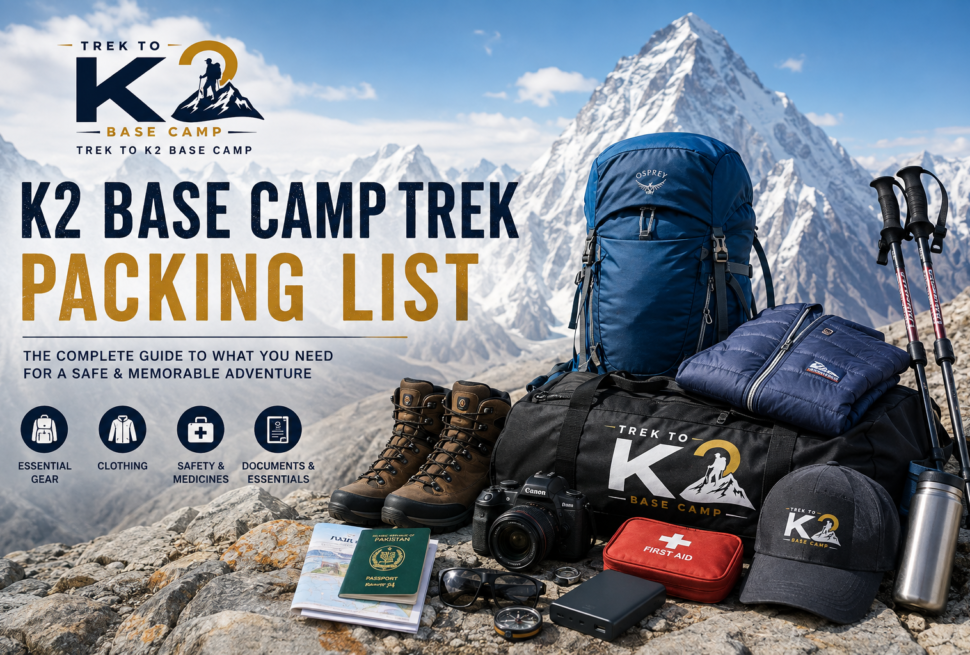
K2 Base Camp Trek Packing List
Packing the right equipment is one of the most important steps in preparing for the K2 Base Camp Trek. Weather conditions in the Karakoram can change quickly, with warm sunshine during the day and freezing temperatures at night. A well-planned packing list ensures that you remain comfortable, safe, and prepared throughout the expedition.
The key to successful packing is using a layering system, allowing you to add or remove clothing depending on the weather and altitude. Avoid overpacking, as unnecessary weight can make the trek more difficult. Focus on high-quality clothing and equipment designed for mountain environments.
Most professional trekking companies provide tents, dining equipment, and group camping gear. Trekkers are generally responsible for bringing their personal clothing, sleeping bag, trekking equipment, and essential accessories.
Essential Clothing
Waterproof jacket
Waterproof trousers
Down jacket
Fleece jacket
Thermal base layers (top and bottom)
Trekking trousers (2–3 pairs)
Moisture-wicking trekking shirts
Warm hat (beanie)
Sun hat or cap
Neck gaiter or buff
Warm gloves
Waterproof outer gloves
Hiking socks (4–6 pairs)
Comfortable underwear
Footwear
Waterproof trekking boots (well broken-in)
Lightweight camp shoes or sandals
Gaiters (recommended for glacier sections)
Sleeping Equipment
Sleeping bag rated to -15°C to -20°C
Sleeping bag liner (optional)
Inflatable travel pillow (optional)
Trekking Equipment
Trekking poles
Daypack (25–35 liters)
Duffel bag (usually carried by porters)
Rain cover for backpack
Headlamp with spare batteries
Water bottles or hydration bladder (2–3 liters)
Power bank
Solar charger (optional)
Sunglasses with UV protection
Personal Essentials
Sunscreen (SPF 50+)
Lip balm with SPF
Toothbrush and toothpaste
Wet wipes
Hand sanitizer
Quick-dry towel
Personal medications
Basic first aid kit
Blister treatment
Toilet paper
Passport
Travel insurance documents
Cash (Pakistani Rupees)
Optional Items
Camera
Drone (where permitted)
Binoculars
Notebook
Kindle or book
Playing cards
Lightweight tripod
Packing Checklist
Category
Essential Items
Clothing
Down jacket, thermals, waterproof layers
Footwear
Trekking boots, camp shoes, gaiters
Sleeping
Sleeping bag, liner
Equipment
Trekking poles, backpack, headlamp
Electronics
Power bank, charger, camera
Personal Items
Sunscreen, toiletries, medications
Documents
Passport, insurance, cash
💡 Expert Tip: Test all your equipment before departure, especially your trekking boots. Never wear brand-new boots for the first time on the K2 Base Camp Trek, as they can cause painful blisters and significantly reduce your comfort during the expedition.
Permits for the K2 Base Camp Trek
Trekking to K2 Base Camp requires several permits and official approvals because the route passes through a restricted and sensitive border region in Gilgit-Baltistan, Pakistan. These regulations are in place to ensure the safety of trekkers and to monitor travel in this remote mountain area.
For international trekkers, the required permits are normally arranged by a licensed local trekking company before the expedition begins. This means that if you book your trek through a professional operator, you generally do not need to worry about the permit application process, as all necessary paperwork is handled on your behalf.
The permit process usually requires copies of your passport, Pakistani visa, and personal travel details several weeks before your arrival. Once approved, the permits are checked at various military and security checkpoints along the route to Askole and beyond.
Independent trekking is generally not permitted in the K2 region. Foreign trekkers are required to travel with a licensed trekking company, accompanied by a registered guide, in accordance with local regulations.
To avoid delays, it is recommended to confirm your booking well in advance so your trekking company has enough time to complete all permit formalities before your arrival in Pakistan.
Permits Required
Depending on current government regulations, the following documents may be required:
Restricted Area Permit (if applicable)
Trekking registration and government approvals
National Park or conservation fees (where applicable)
Passport copy
Valid Pakistani visa
Travel insurance details (recommended)
Who Arranges the Permits?
If you book your trek with a licensed trekking company such as Trek to K2 Base Camp, the company normally takes care of:
Permit applications
Government paperwork
Trek registration
Route permissions
Coordination with local authorities
Guide and support staff arrangements
This allows you to focus on preparing for the adventure while leaving the administrative process to experienced professionals.
💡 Expert Tip: Always choose a licensed trekking operator with experience in the Karakoram region. An experienced company ensures that all permits, logistics, transportation, accommodation, guides, and safety arrangements are properly organized before your trek begins.
K2 Base Camp Trek Cost
The cost of the K2 Base Camp Trek varies depending on the duration of the itinerary, group size, services included, and whether you choose a private or group departure. Although it is one of the world’s most remote trekking adventures, the experience includes extensive logistical support, making it excellent value for a once-in-a-lifetime expedition.
A standard trekking package typically includes transportation between Skardu and Askole, professional guides, porters, camping equipment, meals during the trek, accommodation, and all necessary logistics required to safely complete the journey.
Group departures are generally more affordable because the overall operating costs are shared among participants. Private treks offer greater flexibility but usually come at a higher price.
Before booking, always check what is included and excluded in the package to avoid unexpected expenses during your trip.
What is Usually Included?
Most professional K2 Base Camp trekking packages include:
Three freshly prepared meals per day during the trek
Drinking water purification
Government taxes and applicable permits
First aid and basic safety equipment
What is Usually Not Included?
The following items are commonly excluded:
International flights
Pakistani visa fees
Personal travel insurance
Personal trekking gear
Sleeping bag (if not included in the package)
Personal porter (optional)
Tips for guides and porters
Personal snacks and beverages
Laundry and personal expenses
Emergency evacuation costs
Factors That Affect the Price
Several factors influence the total cost of your trek:
Group size
Trek duration
Private or group departure
Accommodation standard in Skardu
Seasonal demand
Additional services such as a personal porter or private transfers
Larger groups often benefit from lower per-person costs, while private expeditions provide a more customized experience.
Is the K2 Base Camp Trek Worth the Cost?
Absolutely. The K2 Base Camp Trek is widely regarded as one of the greatest trekking adventures in the world. The combination of world-class mountain scenery, experienced guides, full logistical support, and access to one of the most remote regions on Earth makes it an exceptional value for serious adventure travelers.
Unlike many trekking destinations, reaching K2 Base Camp requires a significant support team, including guides, cooks, porters, transportation, and camping equipment. Your trekking fee helps ensure a safe, well-organized, and enjoyable expedition while also supporting local communities and creating employment opportunities in the Karakoram region.
💡 Expert Tip: Choosing the cheapest package is not always the best option. Look for a company with experienced guides, quality camping equipment, reliable logistics, transparent pricing, and strong safety standards. A well-organized expedition can make a significant difference to your overall trekking experience.
The K2 Base Camp Trek is considered a safe adventure for well-prepared trekkers who travel with an experienced and licensed trekking company. Although the trek takes place in one of the world’s most remote mountain regions, professional expeditions follow carefully planned itineraries, employ experienced local guides, and prioritize safety throughout the journey.
The trekking route itself is non-technical, meaning no climbing experience or mountaineering skills are required. However, trekkers should be prepared for long hiking days, high altitude, changing weather conditions, and remote wilderness. Proper preparation, physical fitness, and following your guide’s instructions are essential for a safe and enjoyable experience.
Professional trekking teams continuously monitor weather conditions, campsite safety, and the health of all participants. Daily trekking distances are planned to allow gradual acclimatization, helping reduce the risk of altitude sickness. Guides are also trained to recognize the early signs of Acute Mountain Sickness (AMS) and take appropriate action if required.
One of the biggest advantages of joining an organized expedition is the presence of a full support team, including licensed guides, experienced cooks, porters, and logistics staff. Their local knowledge and experience in the Karakoram Mountains significantly improve both safety and overall trekking experience.
While the K2 Base Camp Trek is challenging, thousands of trekkers from around the world successfully complete it every year. With proper preparation, suitable equipment, and a reputable trekking company, it is considered one of the world’s safest high-altitude trekking adventures.
Safety Tips for Trekkers
To ensure a safe and enjoyable trek:
Join a licensed and experienced trekking company.
Follow your guide’s instructions at all times.
Walk at a slow and steady pace.
Stay hydrated by drinking 3–4 liters of water daily.
Never ignore symptoms of altitude sickness.
Wear appropriate clothing for changing weather conditions.
Carry personal medications and a basic first aid kit.
Purchase comprehensive travel insurance that covers high-altitude trekking and emergency evacuation.
Inform your guide immediately if you feel unwell.
Emergency Support
Professional expeditions are prepared to handle emergencies through experienced guides, first aid equipment, satellite communication (when available), and coordination with local rescue authorities if required. Although emergency evacuations in the Karakoram can be challenging due to weather and the remote terrain, trekking companies follow established emergency procedures to respond as quickly and safely as possible.
💡 Expert Tip: Your choice of trekking company is one of the most important safety decisions you will make. Select a licensed operator with experienced guides, quality equipment, and a proven safety record rather than choosing solely based on price.
Internet Access on the K2 Base Camp Trek
Internet connectivity during the K2 Base Camp Trek is extremely limited due to the remote nature of the Karakoram Mountains. While you can enjoy reliable internet access before the trek begins, you should expect little to no connectivity once you enter the mountain region.
In Skardu, high-speed mobile data, Wi-Fi, and internet services are widely available. This is the best place to download offline maps, inform family and friends of your travel plans, back up photos, and complete any online work before the expedition begins.
After leaving Skardu, Shigar still has mobile network coverage and internet access, although speeds are generally much slower and less reliable. It is sufficient for basic messaging and occasional browsing but should not be expected to support heavy internet use.
Once the drive continues towards Askole and the trek officially begins, internet access becomes extremely limited. Beyond Askole, mobile networks are either unavailable or so weak that they are generally unusable. Throughout the Baltoro Glacier, Concordia, and K2 Base Camp, you should expect no regular mobile signal or internet connectivity.
Some professional trekking teams carry satellite communication devices for emergency purposes, but these are not intended for personal internet use. The lack of connectivity is part of the adventure, allowing trekkers to fully disconnect from daily life and experience one of the world’s last truly remote wilderness areas.
Internet Availability by Location
Location
Internet Availability
Islamabad
✅ Excellent
Skardu
✅ High-speed Wi-Fi and mobile internet
Shigar
⚠️ Available but slow and limited
Askole
⚠️ Very limited and unreliable
Jhula
❌ No internet
Paiyu
❌ No internet
Khoburtse
❌ No internet
Urdukas
❌ No internet
Goro II
❌ No internet
Concordia
❌ No internet
K2 Base Camp
❌ No internet
Staying Connected
Before leaving Skardu, it is recommended to:
Inform family and friends about your itinerary.
Download offline maps and travel documents.
Save emergency contact numbers.
Back up important photos and files.
Complete any urgent online work before entering the mountains.
During the trek, enjoy the opportunity to disconnect from digital distractions and fully immerse yourself in the extraordinary landscapes of the Karakoram.
💡 Expert Tip: Carry a fully charged power bank or solar charger, as electricity and charging facilities are generally unavailable after leaving Askole. Keeping your phone charged is useful for photography, offline navigation, and emergency situations, even without internet access.
Frequently Asked Questions
Before planning your K2 Base Camp Trek, many trekkers have common questions about the route, fitness, permits, accommodation, safety, and the best time to visit. Below are answers to some of the most frequently asked questions to help you prepare for your adventure.
💡 Tip: If you don’t find the answer you’re looking for, feel free to contact our team. We’re happy to help you plan your K2 Base Camp Trek.
How difficult is the K2 Base Camp Trek?
The K2 Base Camp Trek is considered a challenging high-altitude trek. It requires good physical fitness, endurance, and the ability to walk 6–9 hours per day over rocky trails and glaciers. No technical climbing skills are required.
What is the best time to trek to K2 Base Camp?
The best trekking season is from late June to early September, with July and August offering the most stable weather and the clearest mountain views.
How high is K2 Base Camp?
K2 Base Camp sits at approximately 5,150 meters (16,896 feet) above sea level.
Do I need previous trekking experience?
Previous trekking experience is helpful but not essential. Beginners with good physical fitness and proper preparation can successfully complete the trek with a professional guided expedition.
Do I need a permit for the K2 Base Camp Trek?
Yes. International trekkers require official permits to visit the K2 region. These permits are usually arranged by your licensed trekking company before the expedition.
Can I trek to K2 Base Camp independently?
No. International trekkers are generally required to join a licensed trekking company with a registered guide due to government regulations and the remote nature of the route.
What accommodation is available during the trek?
You’ll stay in comfortable hotels in Skardu before and after the trek, while accommodation during the expedition consists of fully supported mountain camping with sleeping tents, dining tents, and kitchen facilities.
Is altitude sickness common?
Altitude sickness can affect anyone above 3,000 meters, but following a gradual itinerary, staying hydrated, and trekking at a steady pace greatly reduce the risk.
Is internet available during the trek?
Reliable internet is available in Skardu. After leaving Askole, mobile signals and internet access are extremely limited or unavailable throughout the trek.
How much does the K2 Base Camp Trek cost?
The cost depends on the itinerary, group size, and services included. Most trekking packages cover accommodation, transportation, guides, meals during the trek, camping equipment, and logistical support.
What fitness level is required?
A good level of physical fitness is recommended. Trekkers should be comfortable hiking for several consecutive days on uneven terrain while carrying a small daypack.
What should I pack for the trek?
Essential items include waterproof trekking boots, warm layered clothing, a down jacket, sleeping bag, trekking poles, sunglasses, sunscreen, a headlamp, personal medications, and a power bank.
Is the K2 Base Camp Trek Guide suitable for beginners?
This K2 Base Camp Trek Guide is designed for anyone planning the trek, but the trek itself is recommended for physically fit hikers with previous multi-day trekking experience.
Ready to Experience the K2 Base Camp Trek?
Standing beneath K2 (8,611 meters) is a dream shared by adventure lovers around the world. From crossing the legendary Baltoro Glacier to witnessing the breathtaking panorama at Concordia, every step of this journey offers unforgettable memories in the heart of the Karakoram Mountains.
At Trek to K2 Base Camp, we specialize in professionally organized expeditions with experienced local guides, reliable logistics, comfortable camping, and personalized support from the moment you arrive in Pakistan until your adventure is complete. Whether you’re joining a scheduled group departure or planning a private expedition, our team is committed to making your trek safe, enjoyable, and truly unforgettable.
Explore our upcoming departures, choose the itinerary that best suits your schedule, and begin planning one of the world’s greatest trekking adventures today.
Ready to take the first step toward the adventure of a lifetime?
✔️ Professional local guides ✔️ Licensed trekking company ✔️ Comfortable hotels & fully supported camping ✔️ Small groups & private departures ✔️ Transparent pricing with no hidden costs ✔️ Expert support before and during your trek